South Saharan Social Development Organization, SSDO featured in Ford Foundation’s documentary on the importance of civil society and civic space for a vibrant democracy. The video draws attention to the relevance of civil societies by highlighting inspiring examples of the institution’s value in addressing complex issues. Ford Foundation presented this documentary at the Summit for Democracy organized by the U.S government.
SSDO has been a voice of advocacy championing good governance and education causes, specifically in the southeast region. We campaign and draw awareness to critical issues in society, such as water scarcity, and campaign to cancel the controversial life pension bills for ex-governors in the Enugu state.
Democracy gives certain rights to you as a citizen, and one is a right to be heard. Another expectation is the protection of your human rights. Democratic governance goes in tandem with protecting human rights and the rule of law. But repeatedly, this right has been neglected or outrightly abused by the government who is supposed to protect it.
The civic society is a key actor for bringing such rights infringement from mostly the community level to the front burners at a national scale. To ensure that laws and policies are enacted and implemented to resolve such issues.
Advocacy is a tool civil societies use to call the government to order and ensure they uphold human rights. It ensures that citizens’ voices are heard, particularly the vulnerable or marginalized. To defend their rights, have their views sincerely considered when decisions about their lives are made. In a democratic system of government, advocacy is a critical mechanism through which citizens can make their desires known to the leaders.
In this documentary, SSDO’s Executive Director, Dr. Stanley Ilechukwu joined his voice to other organizations worldwide as they advocate the importance of an enabling environment for civic space. Click here to watch the video.
On the 25th of February 2022, President Muhammadu Buhari passed the Electoral Amendment Bill 2022 into law. Compared to the previous bills, this gives more autonomy to the electoral body, Independent National Electoral Commission (INEC). This law will help the country improve its electoral process and restore citizens’ trust in the process. Here’s what you need to know as active citizens heading to the forthcoming general elections:
Political Neutrality of INEC Personnel
This provision grants political neutrality to INEC officials. With such a sensitive office, it only makes sense that the electoral officials be non-partisan. Even better, it is now backed by law. Any INEC personnel guilty of party affiliation is liable to be fined the sum of 5 million naira or a maximum prison term of two years. This also means that a party member or politician cannot be an INEC staff. This prevents bias and eliminates favoritism. So while at the polls, if you suspect any foul play by an official, you are well within your rights to report such behavior.
Electronic Transmission of Results
INEC now has the authority and monopoly on deciding whether to transmit election results electronically. Compared to what was obtainable before, INEC had to work with the National Assembly and the Nigerian Communication Commission (NCC) to determine if it could transmit results electronically. The elimination of the previous ambiguity and bureaucratic procedure will help fast-track decision-making for the electoral body. This will also enable citizens to monitor result collation in real-time through the media.
Electronic Accreditation of Voters Legalized
The electoral bill now permits INEC to accredit voters using whatever technologies they deem fit. The most prominent and already sampled device is smart card readers. This improves the fluidity of accreditation and eliminates impersonation.
Inclusion of Persons With Disability
This provision mandates INEC to create an enabling environment for vulnerable people, persons with disabilities, and special needs. This way, there’s no limitation for vulnerable people to exercise their rights. As a community-based organization that works daily with vulnerable and marginalized communities, we understand the importance of this provision in creating a truly inclusive society.
Overvoting Redefined
There have been cases of having more votes in a polling unit than the accredited number of voters in that center. This has often been exploited to manipulate the results in previous elections. This provision now makes the deciding factor for determining election results in a polling unit the total numbers of accredited voters against the total number of votes, effectively eliminating manipulation and results doctoring.
On this premise, we would like to encourage the general populace to get their PVCs and be prepared to exercise their franchise. Our lives begin to end the day we become silent about things that matter. Your vote is your tool to enshrine good governance and make your voice heard.
SSDO will continue to be a voice for advocacy, good governance, and a credible electoral process.
The Indigenous People of Biafra (IPOB) have threatened to issue a one-week sit-at-home order in the Southeast. The order will take effect on November 5 if their leader, Mazi Nnamdi Kanu is not released to them by November 4, 2021. Considering the enormous influence the group wields in the Southeast and how effective their previous orders have been, it is safe to say this is no empty threat.
The group previously declared Mondays a sit-at-home in the Southeast, as a form of agitation and solidarity. As well as any other significant day it deems fit to pass across its message. Such as the President’s visit to Imo state in September and Independence day.
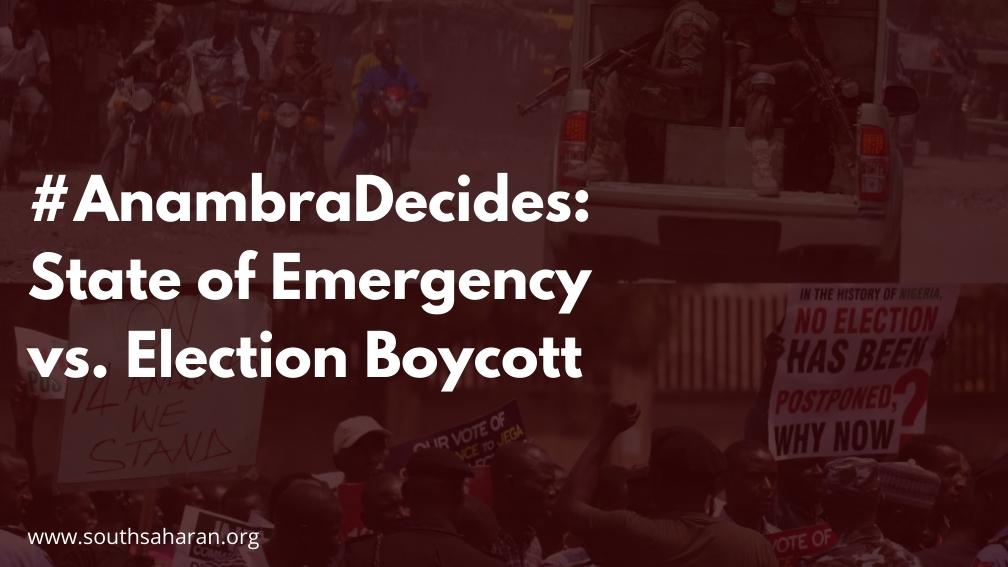
This recent information to enforce a sit-at-home order across the Southeast coincides with the scheduled date for the Anambra Gubernatorial elections on November 6. If this order is implemented, it then will become an enforced election boycott since people will not be able to go out and exercise their civic rights.
In our last piece on the Anambra election, we analyzed the impact of a state of emergency assuming the unrest in the state didn’t subside against an election boycott. Apparently, a state of emergency might not be in the offing anymore, but the possibility of a boycott is becoming more realistic.
Now there are questions that need answers. Will an election boycott be enough to get the election canceled or postponed? Will an election boycott further the group’s goal of secession? Let’s look at popular election boycotts in history and how they turned out as we seek answers.
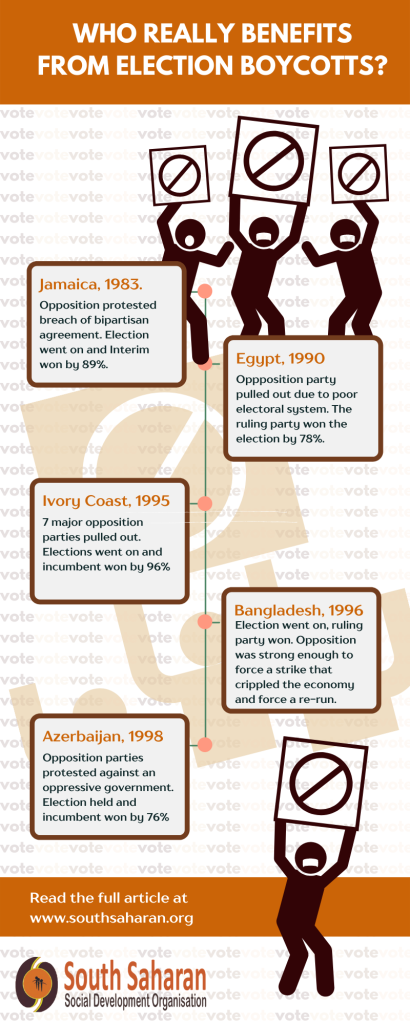
Jamaica, 1983.
The election in 1983 was always a two-horse race between the ruling party, Labour Party, and the People’s National Party. Edward Seaga, the seating Prime Minister at the time was the candidate of the ruling party and former Prime Minister Michael Manley was the leader of the opposition party. Both parties initially agreed the election take place in 1984 when a new voters registration system would be in place.
This system will allow 180,000 new voters to register. The incumbent on sensing the economic downturn and his diminishing popularity decided to have the election hold months earlier. Mr. Manley crying foul boycotted the election stating a breach of bipartisan agreement.
Outcome: The election went on and the opposition lost. The interim Prime Minister won by 89%.
Egypt, 1990.
The four main opposition parties in the country boycotted the election citing cases of rigged elections and reluctance on the part of the government to accept the proposed policies of the opposition parties which include: supervision of election by judges, improvements in accounting for voters, and a suspension of the martial law that has been in place since 1981. The parties stated that unless these policies were adopted, elections will be the same old story.
Outcome: The ruling party, National Democratic Party won the election by 78%
Ivory Coast, 1995.
Interim president Henri Bedie in 1994 approved an electoral code that prevents Non-Ivorians from contesting and voting in the 1995 elections. This code automatically ruled out leading opposition aspirant Alassane Ouattara and was also a move that was perceived by the people as one that will destroy national integration. The seven major opposition parties pulled out of the election in protest of the decision.
Outcome: The election went on and the incumbent won by 96%.
Bangladesh, 1996.
The country has had a series of boycotts that resulted in the birth of the prominent political parties in the country today. The country’s major opposition party at the time, Awami League, championed the push for the boycott. This was because the government refused to inaugurate a caretaker government ahead of the elections, as was the custom in the country. They did this to prevent interference by the incumbent government in the election outcome.
Outcome: The election went ahead, which the ruling party at the time, Bangladesh Nationalist Party, won in a landslide victory. However, the opposition parties instigated a strike that crippled the country and resulted in a caretaker government being installed. They conducted elections in June, and Awami League won the election.
Azerbaijan, 1998.
In Azerbaijan, we also see a case of an election boycott by some political parties who criticize the incumbent government of President Aliev. They claim the government silences its opponent and there have been violations during the pre-election period. There have been reports where the government has jailed journalists, civil society activists, and human rights lawyers.
Outcome: The election held, and the incumbent won overwhelmingly by 76%.
Election Boycott is a Bad Strategy
Going by history, we can see clearly that an election boycott has never really resulted in election cancellation or postponement. And only in Bangladesh was the opposition strong enough to cripple the economy that led to an eventual re-run.
In Iraq in 2005, the Sunnis decided to boycott elections, and this is perceived as one of the greatest strategic blunders in the post-Saddam era. This left them disadvantaged and without a fair share of representation during the formative years of the new Iraq.
IPOB through this mandatory election boycott would disenfranchise citizens from exercising their rights. Better still, a galvanized approach to push for a candidate who is sympathetic to their cause might be a better approach.
South Saharan Social Development Organization (SSDO) is a duly registered non-profit organization in Nigeria, with a primary focus on equipping women youth, and children with the social, health, economic, educational, and political skills needed to survive and compete favorably in a vastly changing and urbanizing sub-Saharan Africa.
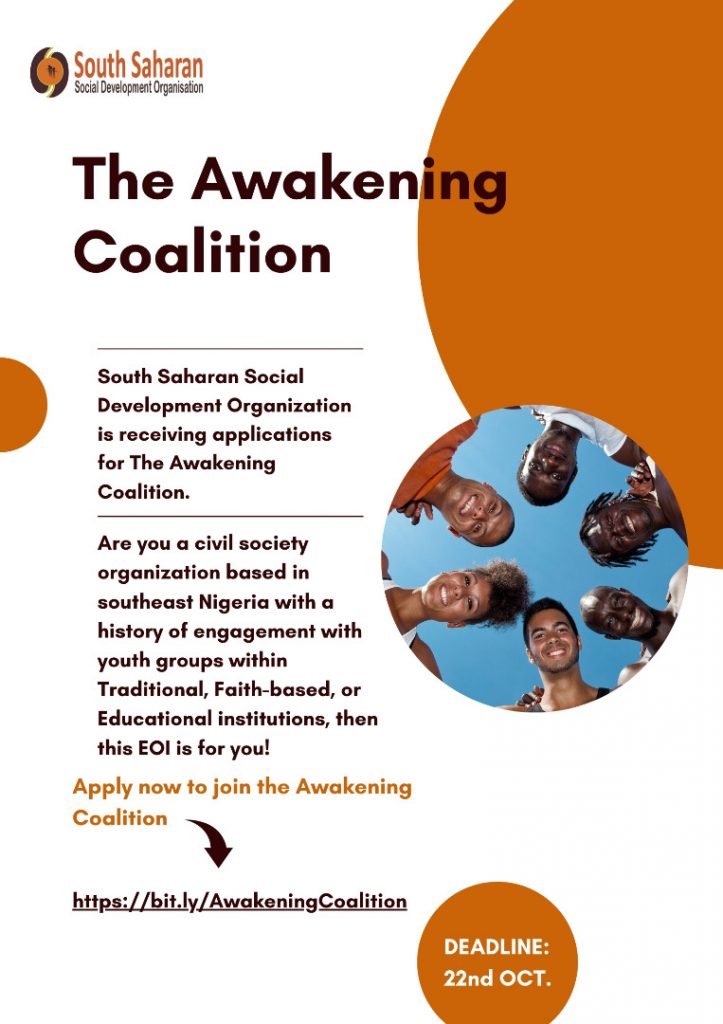
SSDO is accepting expressions of interest from youth-led and youth-focused CSOs in the Southeast to form an Awakening coalition. Organizations who have successfully executed projects in the governance space are encouraged to apply, particularly those with verifiable evidence of engaging youth within any of the following institutions/groups:
1. Tertiary Educational Youth Groups/Institutions
2. Faith-Based Youth groups/Institutions
3. Traditional Youth group/Institutions
The Awakening is a youth-focused civic enlightenment program aimed at enlightening young people in the South East on good governance, democratic principles, civic participation, and active citizenship in order to awaken them to their civic responsibility and provoke them into demanding full representation, involvement, and active participation in decision making and governance. Since 2015, the program has engaged youth mainly through the Awakening radio hour on youth-centered radio stations (Dream FM Enugu, Flo FM Umuahia, and Radio Nigeria southeast zonal station) and youth clubs on good governance, civic engagement, and civic education across southeast Nigeria.
ELIGIBILITY CRITERIA
CSOs must be based in the South East.
Must be youth-led and youth-focused.
Must be duly registered with CAC
Have a physical office location in southeast Nigeria.
Must have worked with either of the following: Tertiary Educational Youth Groups/Institutions, Faith-Based Youth groups/Institutions, Traditional Youth group/Institutions
DEADLINE
All applications should be submitted on or before October 22, 2021.
As the election draws close, there has been a drastic increase in violence, loss of lives, and property in Anambra State. From the destruction of the INEC state office in May where three people died, non-sensitive election materials destroyed, seven vehicles, and 50 generating sets burnt, to several reports of killings and attacks on properties of individuals.
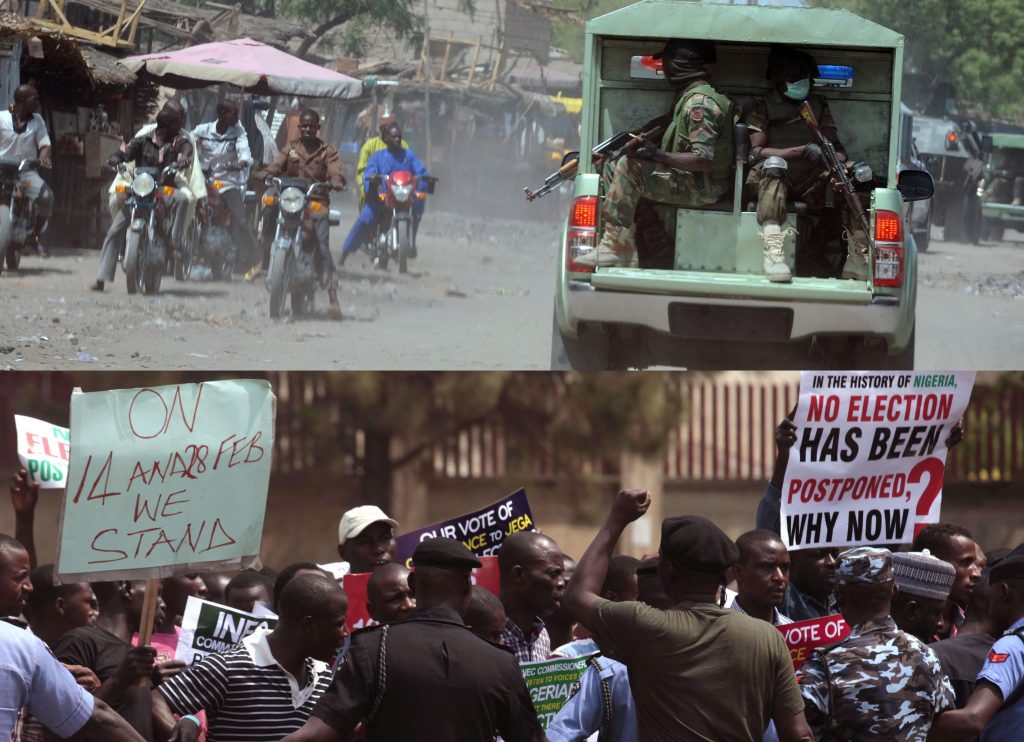
Calls from certain groups encouraging people to boycott the elections have left uncertainty in the air. The Attorney General and Minister of Justice, Abubakar Malami, while addressing the press after the Federal Executive Council meeting on Thursday, stated that no possibility is ruled out, citing the security breaches and instances of the breakdown of law and order as references that could require the declaration of a state of emergency in the state.
State of emergency: The way to go?
A state of emergency is a government declaration, an express directive by the executive to handle a difficult situation such as a natural disaster, violence, pandemic, civic unrest or insecurity that threatens the country. It brings to a halt the normal functioning of the government. When triggered by violence and insecurity, it could lead to a takeover by the military. A state of emergency grants special powers to the government to restrict press freedom, evacuation of people from their homes, searching of homes and private places without a warrant, and confiscation of properties among other things. It also leads to curfews and restrictions on the economic, civil, and political rights of the citizens as soldiers take to the streets, empowered by law to make arrests, and detain suspects.
There is a certain fear that comes with having the army walk the streets. Long after normalcy returns, people will still be wary of moving, talk less of going to join queues to vote. A state of emergency can also be wielded by the government as seen in the past to postpone elections or neutralize opponents. It begs the question, is it the right call to be made barely a month to the Anambra elections?
Some might argue that the situation in Anambra hasn’t yet gotten to the point where a state of emergency should be declared. So far, going by the reports, 15 have died in political killings, which while unfortunate isn’t beyond what the Police can manage. A state of emergency might be perceived as a plot by the central government to postpone the election or better still, be a tool to tilt the scales in the favor of the ruling party.
The IPOB Factor
Though the group has been proscribed and labeled a terrorist organization by the federal government, their influence is still strongly felt in the South East. For the past few months, there has been a sit-at-home order in the southeast every Monday in solidarity with their detained leader, Mazi Nnamdi Kanu. This instruction has been strictly obeyed across the eastern states. And in cases where the rules have been flouted, it has been a guerilla-like punishment as footage has surfaced online where vehicles and properties of defaulters have been set ablaze.
It is also known that this group has dissociated itself from anything that has to do with the central government as it also declared the 1st of October, Nigeria’s Independence day a sit at home. There have always been calls by this group for election boycott in the east, precisely Anambra state. Reports reveal that during the 2017 elections the group also encouraged people to boycott the election. Going by their agenda for secession, it shouldn’t be any different now.
Boycotting: A Solution or Complication?
Seeing the enormous influence the group holds in the east, should they call for a boycott, there is a good chance people stay in their homes due to fear of reprisals. The group’s reason for this boycott is oppression and marginalization by the current regime. But is boycotting the way to get what they want?
An election boycott can be peaceful and can also be a violence trigger. In Jamaica in 1983, the opposition leader, Michael Manley, instructed that the boycott be peaceful, stating that they seek no confrontation. Whereas in Ivory Coast in 1995, Laurent Gbagbo, the opposition leader at the time was quoted as saying that the opposition has given orders for “maximum disruption”.
If the elections fail to hold either due to a violent boycott or any other reason, the present government will stay on for at least six months according to section 180(3) of the Nigerian constitution. This means that it will not be a lasting solution since the incumbent governor is not their choice.
Over the years, history has shown that it is almost impossible to achieve a total boycott. And oftentimes, the opposition party that chooses the boycott loses outrightly in terms of representation. It happened in Egypt in 1990, Bangladesh in 1996, Azerbaijan in 1998, and 2000. In the last general election in 2019, where about seven million voters registered from the east and only three million voted. If they had all come out to vote, might it have made the difference? Maybe.
But more importantly, a call for a boycott shows that there is a lack of faith in the electoral process or democracy as it is defined.
INEC’s Preparedness
In a conversation with Situation Room Nigeria, the Resident Electoral Commissioner (REC) for Anambra state, Dr. Nkwachukwu Orji confirmed there are 2,525,471 registered voters, 112 new polling units have been added bringing the total to 5,720, and 326 wards in the 21 LGAs.
Dr. Nwachukwu further elaborated that recruitment for ad-hoc staff is ongoing and the agency looks to employ 26,000 people. Accreditation of the press is ongoing and the decentralized ad-hoc staff will be trained in the third week of October. He confirmed the final list of 18 candidates that will contest the election come November 6, 2021.
He stated that non-sensitive materials destroyed during the May attack will be restocked from the southeast zonal store in Imo state.
To Be or Not to Be?
With INEC’s level of preparedness, the level of insecurity in the state, and the looming effect of external groups, will a state of emergency be declared? Will elections hold as scheduled? Or will the voters show apathy by boycotting the election if it eventually holds? Whatever the case might be, wherever the pendulum swings, time will ultimately tell.