SSDO

THE ENUGU GUBERNATORIAL PENSION BILL AND SSDO’S RESPONSE

Protesters making their displeasure known with the 'NoToPoliticalLifePension' placards

Mar. 16, 2021

On the 11th of March 2021, the Enugu State Gubernatorial Pensions Bill scaled the first reading on the floor of the Enugu State House of Assembly. Ever since then, the news has sparked outrage amongst Enugu state residents on social media.

Enugu’s last internally generated revenue (IGR) was 31 billion naira. This is low, compared to the IGR of other states. For instance, Lagos state has an IGR of 398 billion naira, while Rivers state  has an IGR of 67 billion naira. This low level of state IGR is one of the reasons that the Bill, also known as the Life Pensions Bill, has received negative reactions. The bill has been said to be exorbitant and unnecessary in the face of other more pressing issues in Enugu state.

What is the bill about?

The aim of the initiative guides the selection of communities. The selection of communities is The Enugu State Gubernatorial Pensions Bill, if passed into law will repeal the Enugu Gubernatorial Pension Law 2007 and accommodate new amendments including the following:

–        A state-funded burial of an ex-governor

–        Medical allowance worth 12 million naira for a surviving spouse

–        House and vehicle maintenance allowance fixed at 300% of annual salary

–        Salary for 5 domestic staff

–        Equivalent of annual basic salary while in office

–        3 vehicles to be replaced every 4 years

–        Free medical services for the ex-governor and his wife

The life pensions bill is an implementation of the Constitution in Section 124(5). However, with the

excessive amount spent by implementing states, it begs the question, “Is it worth it?”.

22 states currently implement the governors’ pension law with Bauchi (23 billion), Rivers

(2.79billion), Akwa Ibom (2.04 billion), and Lagos (1.6 billion) doling out the highest amount.


Swimming against the tide

With the recent economic difficulties, there have been agitations by civil society groups for state governments to abolish this law. The current law which this bill seeks to replace, already eats deep into the states’ coffer. Therefore, it would not be sufficient for the state to scrap the current bill in deliberation, they must also repeal the already enacted Enugu Gubernatorial Pensions Law 2007 and 2017. This will substantially free up funds to be channeled to more urgent areas of governance.

In November 2020, the Lagos state government, under the leadership of Babajide Sanwoolu, passed a bill to eradicate their own version of this law, the Public office Holder (Payment of Pensions Law 2007). Kwara, Zamfara, and Imo states have followed suit. Akwa Ibom, Adamawa, Sokoto, and Enugu state were among the states who have shown little or no willingness to repeal the law. Enugu state, however, took it a step further by introducing a new bill to further solidify the status quo. 


Why is it uncalled for?

Enugu’s state IGR for the last fiscal year is approximately 31 billion naira compared to Lagos’s 398 billion naira. If Lagos whose revenue is ten times that of Enugu plans to scrap such a law, why should Enugu do the direct opposite, further diminishing available resources?  The state owes its retirees 24 billion naira from 2010 to 2019, and pensioners have been demanding to be paid, to no avail. The state also struggles with water scarcity, with water steadily getting more expensive and less available. The recent hikes in fuel price, electricity tariffs and food costs are already causing people unbearable hardship. Given the current situation of things in the state, this bill is highly insensitive. And the people expect that their elected representatives should understand this.   


File Image: Protesters on a procession through Enugu Metropolis

confirmed

Walking the talk

On the 16th of March 2021, South Saharan Social Development Organization (SSDO), a non-profit
organization in Enugu state, organized a peaceful protest to register its displeasure with the proposed bill. The aim of the protest was to nip the bill in the bud before it could be passed into law. 
The protesters moved past strategic points in the Enugu metropolis, raising awareness. They carried placards with the inscription “No To Political Life Pension.” This caught the attention of well-meaning Enugu citizens, some of who stopped and joined the procession. The march ended at the Enugu State House of Assembly. Media houses arrived in their numbers. The group sang solidarity songs while recounting the problem to the media. After a while, protesters gained access into the complex.

Speaking at the State House of Assembly, the Executive Director, Dr. Stanley Ilechukwu, said, “the NGO joins its voice with that of other well-meaning citizens of the state to condemn the bill.” He also stated that “this egregious bill is a needlessly exorbitant gift for an already well-compensated service to the government.”


File Image: Speaker of Enugu State House of Assembly , Rt Hon Edward Ubosi addressing the protesters

confirmed

Audience with the speaker

On arrival at the base of the complex, the Speaker, Rt. Hon Edward Ubosi addressed the
protesters. He commended the conduct of the exercise. He said the law had existed since 2007, amended in 2017, and this present amendment is to accommodate past governors who are Enugu indigenes.
  

 “We have stepped it down for further considerations. After looking at it, we will form a committee, and invite the public to make their contributions. If you don’t like it, we will cancel it. It is not our bill, it is yours.”


What Next?

The process will be monitored, and we hope that the Speaker keeps his word. We will draw attention to the public hearing once announced. We believe the House should junk this bill in its entirety. The taxpayers are already under enormous strain from the increased cost of living and do not need the added burden of unjustifiable pensions to retired executives. We hope the representatives would do what is right for the people of Enugu, who have entrusted them with their mandate.


By Oduguwa Olusomi

SSDO – ActionAid Partnership: The Journey to Change

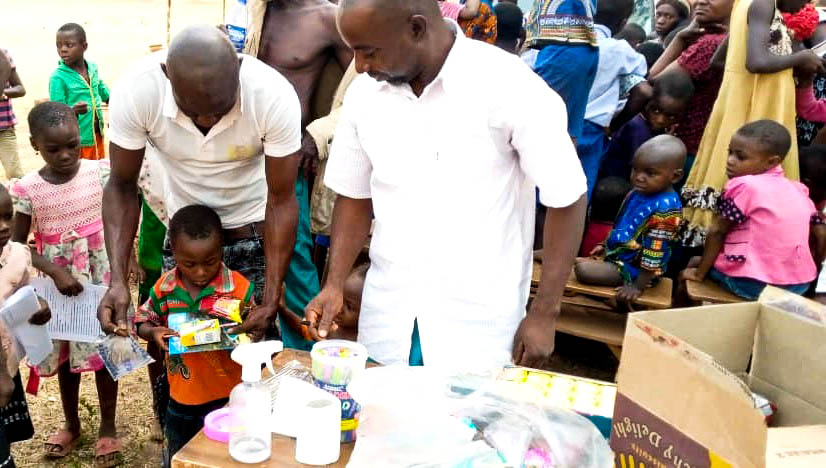
Community Volunteers administering educational materials and drugs to children in Odumachara Community in Enugu State.

Feb. 26, 2021

It was past 11am when the van pulled in to the community. The team spent over 2 hours on the road from Enugu Metropolis to Igga community in Uzo-Uwani LGA. The team was assigned to the only public school to carry out the child profile collection.

As typical with any southeastern rural settlement, the red earth was visible, houses sparsely located and striking was the fact that there was no access to potable water. Further conversation with community members revealed that there hasn’t been light in the community for years.

The community relies on the stream which is located over 2km away from the settlement for its needs. “We use water from the stream to bathe, cook, wash, and drink,” said a child when questioned. A similar scenario was also encountered across the five communities where there were obvious deficiencies of basic amenities. Interestingly, at Oduma Achara, Aninri LGA, two critical observations were made.

Firstly, the unusually high number of private schools in the community, precisely 3 opposes the norm seen in rural communities, and our fieldworker engaged a community member on the subject. “I don’t trust the quality of the government school. They lack teachers.” said a mother of 3 children.

The field worker asked whether she would use the government school if the situation improved, to which the woman answered, “Yes, I will. The private schools are expensive.” 

This initiative identifies vulnerable children aged 3 – 8 years and attaches them to sponsors. Selected communities include Oduma Achara in Aninri LGA, Igga and Nkume in Uzo Uwani LGA and Abor/Isiala in Isi Uzo LGA. 


Facts & Figures

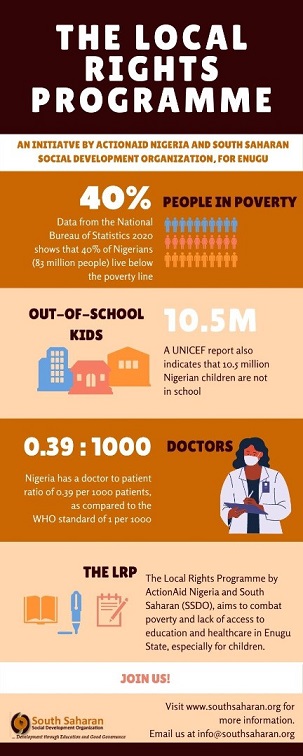
The above issues highlight the problem of poverty, lack of education and healthcare, which are indicators of a deficient system, of which the biggest victims are children. 

Having identified this problem, ActionAid Nigeria has partnered with South Saharan Social Development Organization to find ways to remediate the situation, particularly in Enugu state, through the implementation of the Local Rights Programme (LRP).

The initiative aims to reduce poverty by engaging with the poor and marginalized in selected communities through its child sponsorship mechanisms. 


Community Selection

The aim of the initiative guides the selection of communities. The selection of communities is based on reliable data from the National Bureau of Statistics indicating the poorest geo-political zones in the country. This is then narrowed down to the poorest states and then cascaded to the poorest local governments and communities.

This initiative was first implemented in Ebonyi state. Having achieved success in the state, Enugu state became the next port of call. Before entry into these communities, ActionAid liaises with the appropriate government authorities for ease of access.


File Image: A dilapidated classroom in Oduma-Achara community where pupils learn daily.

confirmed

Disparity in English language proficiency

The second observation made by the team in Oduma Achara, based on interactions with the children, was that most children in the community barely understood or spoke the English Language. Further interaction with the parents showed that they spoke and understood English Language better than the children. Another negation to the norm seen in other rural communities where the children had better fluency in English than the adults.

This observation led to further inquiries using the key informant interview system. Community members and teachers were interviewed and the following reasons were deduced.

The key reason attributed to this observation is that children were predominantly taught in the Igbo language. It is not certain whether this is to aid easy assimilation on the part of the children, or a lack of confidence on the part of the teachers to deliver in English Language.

It was also elucidated that the parents have traveled more. Some adults had contact with the cities at a young age. Some schooled there, and some trade there. Thus, leaving them no choice but to communicate in English which is more predominant in urban areas. Whereas, the children have lived all through in the community.

This observation begs more questions than it gives answers. Is teaching in the local dialect a more effective form? Is there a correlation between language and future success? These and more are questions that we would look to answer in our subsequent publication.

These communities afford us the much-needed opportunity to educate, inform, and advocate for their basic human rights. As well as to point the spotlight on these communities, which would, in turn, get the government to take more decisive actions. We are excited about the possibilities! 


By Oduguwa Olusomi

The Pain of the Pandemic: Chinasa’s Story to Stability

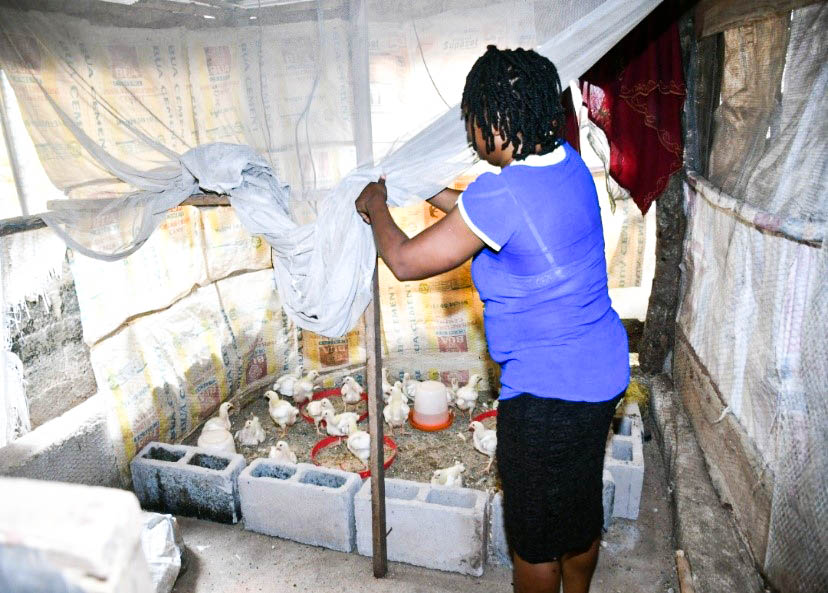
Chinasa's new chicks (gotten from the profit of the first set) -25 chicks

Feb. 23, 2021

“During the lockdown, it was impossible for me to support my family. My husband’s
motorcycling repair job has been affected by the pandemic. I needed to do something about my family’s situation as feeding had become an issue. I anticipated receiving the money. I knew that with it I will be able to get my business running and my family going. The intervention was timely.”

Ngene Chinasa is a mother of five children. She lives in Ndibinagu Umunkwo community, Akegbe Ugwu LGA of Enugu state. Due to the Covid-19 pandemic, things became very difficult for her and her family to survive. Chinasa was unemployed. Her husband is a mechanic, who needs to work long hours daily to earn a living. Life was unbearable, feeding became a struggle.

The effect of the pandemic has been felt by every sector of the economy and every class of people. No one spared. Nigeria is largely dominated by the informal sector which accounts for 60% of the working population. The main characteristic of the informal economy is that money changes hands on a daily, and the survival of workers in this sector is based on them showing up for work every day.

Since the lockdown in March, it has become difficult for informal economy workers like Chinasa’s husband to keep up, seeing that they make money daily.

The complications of COVID-19 didn’t only affect their means of livelihood but also brought about an undue scarcity. She had to walk about 4km with her suckling child to the major road junction, in order to go into town. “You have to call bike men to come to pick you. When they come, you will pay for both trips,” she said. The remote location of the settlement made it unattractive for motorcyclists. This meant that they had to walk if they didn’t want to wait for
hours to get transport. 

Fortunately, Chinasa was opportune to be enrolled on the OVC project by a community volunteer early last year. In September 2020, Chinasa was one of the first beneficiaries under the OVC (Orphans and Vulnerable Children’s) program to benefit from the IGA (Income Generating Activity) intervention supported by the 4Gates project in Enugu state. 

File Image: Receipt of the items for IGA -15 chicks

confirmed

File Image: Bags of feed and medication for the chicks.

confirmed

IGA is one of the implemented initiatives under Household Economic Strengthening, a domain of the OVC project. This initiative is aimed at helping beneficiaries attain economic stability by helping them establish businesses to support their families. “I have been thinking of how to scale through this pandemic. But with the cash, I will be able to provide for my children.”

Chinasa and other beneficiaries were trained on financial education to ensure that the businesses provided would be properly managed and utilized. After the training, she selected poultry as the business venture to embark on. “I had a poultry farm once but couldn’t sustain it due to funds,” she said. 

She has taken full advantage of the initiative and has expanded the poultry business to include a piggery. “So far, there’s been no challenge, and I have been steadily growing the business,” she noted. Chinasa now has a farm with 25 chicks, 7 pigs, and has also started a nursery in her home.


File Image: Birds at 6weeks almost ready for sale.

confirmed

File Image: Chinasa's pig farm (gotten from the profit of the first set) -7 Pigs.

confirmed

“I make 6,000 Naira when I sell a chicken, and at least 50,000 Naira for a matured pig,” Chinasa stated. Her story has changed from what it used to be during the lockdown. She can now adequately support her family and have some savings.

35 people have been empowered so far by the initiative. The project is supported by CARITAS – 4GATES and implemented by South Saharan Social Development Organization (SSDO). 


By Oduguwa Olusomi

LEADERSHIP DURING STRIFE: The Bishop’s Tale

Bishop Njoku feels the weight of his responsibilities as the pandemic persists

Feb. 9, 2021

In turbulent times, Bishop David Njoku keenly feels the burden of the mantle. As Bishop of the Apostolic Church of Christ, Oduma-Achara, Aninri LGA, Enugu State, he represents hope and guidance for his flock. “A lot of people depend on us, the church, for information and directives,” he says. 

The 67-year-old Bishop is particularly concerned about the economic impact of COVID-19 on Oduma-Achara, a small agrarian village with two lakes that dry out during harmattan, and no functional water facilities. “COVID-19 was a very big challenge to our people; it affected our farming and harvesting. To the extent that our women sold a basin of Okro for N150 (39 cents).” The hardship and scarcity of water has created some unusual items of luxury; GP water tanks are now highly prized among indigenes living in Oduma, and are even requested as part of the bride price. Bishop Njoku worries that the people are not taking hygiene seriously to prevent more outbreaks and other diseases. With a wife and 8 children of his own, he is understandably invested in maintaining hygiene protocol, constantly reminding people to wash their hands before entering the church premises. Yet generally in Oduma hygiene is poor. Open defecation is still widely practiced, and handwashing is only observed in school, at the Igwe’s palace and in church.


File Image: A young woman wondering about the next step as the lake has dried up

confirmed

The intervention by WaterAid and SSDO could not have come at a better time. The Scale Up Hygiene Project, sponsored by the Heineken Africa Foundation, targeted 6 states including Enugu for the promotion of hygiene messages in response to COVID-19. The project utilized radio and TV jingles featuring prominent traditional and religious leaders urging Enugu residents to take the pandemic seriously, wash their hands and wear face-masks. In addition, the jingles were aired in markets in 6 different LGAs coupled with the distribution of IEC materials with instructions on hand-washing, safe waste disposal and other beneficial hygiene behaviours. Hygiene packs were equally distributed to vulnerable households in 7 LGAs.

Bishop Njoku is pleased with the positive response to the messages. “Because of the sensitization, radio programs and IEC materials provided for us, we were able to teach them proper handwashing which they practiced despite the scarcity of water. Our children have also learnt how to use face masks. Our knowledge of hygiene has increased.” However, he notes that access to clean, drinking water is still a major challenge to reinforcing hygiene behaviours, and calls on the state government to urgently install water facilities to help improve the quality of life in Oduma-Achara.


By Ijeoma Ossi

The Awakening Townhall Series 2020

A report on the Awakening Interactive Townhall Sessions held across the five states of southeast Nigeria on “The Emerging Roles of Young People in Good Governance” : 9th – 12th November, 2020

Introduction

The Awakening is a civic enlightenment program that aims to combat political apathy amongst youths in Southeastern Nigeria. The program is funded by OSIWA/DFID and implemented by South Saharan Social Development Organization (SSDO). The Awakening program aims to build the capacity of youth in southeast Nigeria on citizens’ rights and responsibility, democracy, good governance and public accountability.

In November 2020, the Awakening organized a series of town hall meetings across the 5 southeast states. The town hall meetings featured twenty-five youth leaders from each state, drawn from non-governmental organizations, student bodies, media and other sectors. The theme of the townhall was –“The Emerging Roles of Young People in Good Governance” and the objectives were as follows:

  • To identify key governance issues affecting young people in the southeast states.
  • Explore various options available for proactive youth involvement in good governance.
  • Develop actionable steps and strategies for ensuring youth participation in good governance.

Key Governance Issues/Challenges Identified

The Town Hall Meetings took the experiences of the participants into account in detailing a situation analysis of governance in the southeast states. The key governance issues affecting the youth were outlined as follows:

  1. Favouritism and mediocrity engenders a sectionalist governance structure that repress youth because of the social, cultural or political affiliations.
  2. Sycophancy is expected of and expressed among youth whose opinions on governance are taken seriously by the ruling class.
  3. Lack of accountability among youth organizations.
  4. Insensitivity among youth wielding political officers to fostering governance agenda.
  5. A lack of political space for participation makes it difficult for the youth to aspire to public offices. This affects women disproportionately.
  6. Ignorance and a lack of exposure limits the capacity of the youth to identify core governance issues, plan and execute set objectives (where they exist).
  7. Poverty and a poor mind-set limits the ability of the youth to reject tokens from political agents and engage meaningfully with the government.
  8. Voice is not given the youth and there are no safe platforms that will allow them to speak up for change they want.
  9. Inconsistency of message and affiliations to goals and ideologies limits the capacity of the youth to take a stand on good governance.
  10. God-fatherism puts a leash on progressive youth who may wish to pursue good governance goals in the state.
  11. A lack of mentorship is a big issue for youth who are unable to find role models of good governance activists in the state.
  12. Thuggery and Hooliganism, implying the use of violence in the resolution of governance issues by the youth create further problems.
  13. Lack of information from government programs (such as budget planning and reviews) make it difficult to assess and demand governance
  14. Poor lobbying and advocacy skills among the youth
  15. Weak government institutions

Recommendations

The major recommendations made include the following:

  1. Form a network of young people with knowledge, hands-on experience in various fields in the southeast. It will feature periodic interactions, exchanges and strategies to monitor and facilitate good governance.
  2. Conduct regular enlightenment campaigns on youth participation in governance and political education for youth using social media, town hall meetings, seminars and school-based sensitization programs at all levels.
  3. Combat poverty among the youth by economic capacity building through training in Agrobusiness such as rice farming, ICT/Digital marketing and metal fabrication among others; as well as, advocacy for tax waivers and incentivisation of Youth-owned Micro, Small and Medium Enterprises (MSMEs). These training activities will be conducted in partnership with relevant institutions such as National Directorate on Employment (NDE), Industrial Training Fund (ITF), Small and Medium Enterprises Development Agency of Nigeria (SMEDAN), Local Governments (LGs), Civil Society Organizations (CSOs) and Community Based Organizations (CBOs).
  4. Provide financial education to youth who operate MSMEs in the southeast.
  5. Facilitate a value re-orientation to restore the confidence of the youth in participating in good governance initiatives. This can be coordinated in partnership with the National Orientation Agency (NOA).
  6. Establish independent funding and sponsorship streams from NGOs, public spirited individuals and corporate organization to finance good governance initiatives.
  7. Conduct policy appraisal events where young people can contribute to policy develop as well as query implementation. An example is to hold a yearly budget appraisal conference.
  8. Conduct excursions for select southeast youths by taking them to big cities and events where they can interact with and learn from other young people from elsewhere.
  9. Organize youth-driven mentorship and co-mentorship programs. 
  10. Conduct constructive engagement with major stakeholders including religious leaders, councillors, traditional rulers via open dialogues on good governance for southeast states using phone in programs on television and radio platforms.
  11. Encourage youth participation in politics (as both active voters and contestants) and advocate against unnecessary political cross carpeting.
  12. Advocate for financial subsidies on fund requirements for contesting elective positions by young people.
  13. Form a youth-led political movement via registration of a political party, repurposing of an already existing party or the formation of stronger and more independent youth wings within all political parties.
  14. Establish Citizens Accountability Clubs in partnership with CSOs, CBOs, National Youth Service Corps Members, students, town unions and age grade groups. The club will conduct grassroots sensitization.
  15. Create information network for deliberate dissemination of information on good governance. Media for information sharing will include social media, press conferences, radio/television engagements, flyers, billboards, etc. The media employed will be subject to funds available.

Each person in attendance committed to sharing the outcomes of the meetings with other youths in their networks, with the aim of developing an action plan that is specific, measurable, achievable, realistic, time bound, gender sensitive and legal to encourage good governance in southeast Nigeria.