

South Saharan Social Development Organisation (SSDO) advances subnational governance reform in Enugu State through evidence-based frameworks that strengthen accountability, improve public institutions, and enhance service delivery.
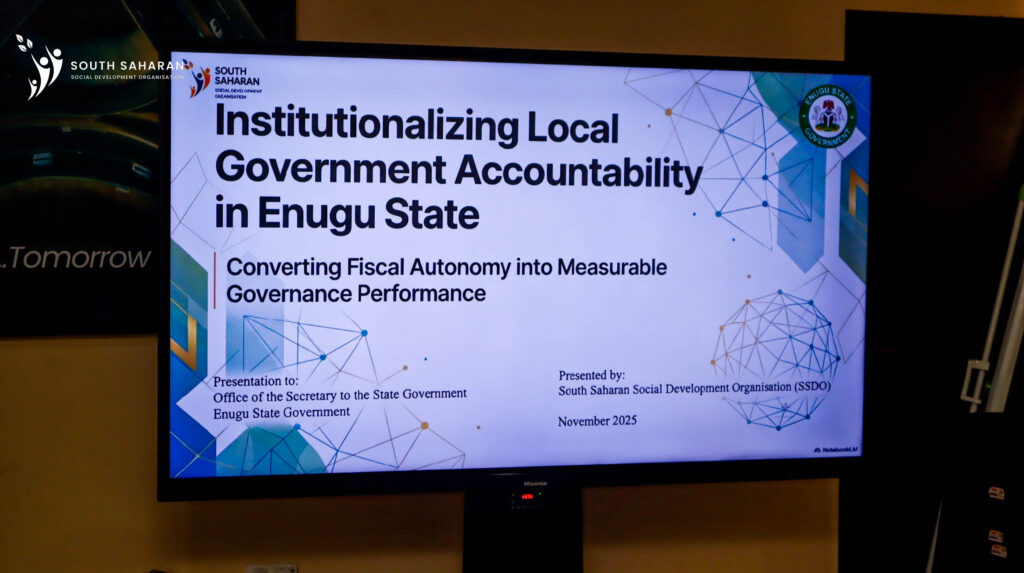
The Local Government Accountability Index framework presentation to Enugu SSG marked an important step in ensuring that governance data informs decision-making at the highest level of state government.
Strong local governance requires credible evidence that helps policymakers identify institutional strengths, address performance gaps, and implement reforms that improve outcomes for citizens.

Strengthening Local Governance Through Evidence
Local Government Areas (LGAs) remain the closest level of government to the people. They are responsible for delivering essential public services and implementing policies that directly affect communities. Despite this central role, local government performance is often measured through perception rather than structured evidence.
Without reliable performance data, it becomes difficult to identify systemic challenges, prioritise reforms, or allocate resources effectively. Evidence-based assessment provides government institutions with a clearer understanding of what is working, where weaknesses exist, and what interventions are required to strengthen governance.
Recognising this need, SSDO with support from the Policy and Legal Advocacy Centre (PLAC) through the Nigeria Civil Society Situation Room, and funding from the UK Foreign, Commonwealth and Development Office (FCDO) under the PACE Programme Component 3, developed and piloted the Local Government Accountability Framework and Policy as a practical tool for measuring institutional performance across local government systems in Enugu State.
The Local Government Accountability Index Framework
The Local Government Accountability Index Framework provides a structured methodology for assessing governance performance across Enugu State’s 17 Local Government Areas.
SSDO trained local government officials and civil society stakeholders to implement the framework effectively. These trained stakeholders conducted field assessments across all 17 LGAs in Enugu State, using five governance pillars:
1. Transparency: The framework examined how accessible and open local governments are in providing public information and promoting openness in decision-making.
2. Public Participation: The assessment evaluated opportunities for citizens to engage in governance processes and contribute to decisions affecting their communities.
3. Fiscal Accountability: Financial management systems, documentation practices, and accountability mechanisms were assessed to determine how public resources are managed.
4. Service Delivery: The framework considered the effectiveness of local governments in delivering services that meet the needs of citizens.
5. Rule of Law: The assessment reviewed institutional practices that support fairness, compliance, and accountability within local governance systems.
Together, these indicators provide an evidence-based picture of governance performance and identify areas where institutional strengthening is needed.
Presenting Evidence to Inform State-Level Decision Making
Following completion of the assessment, SSDO presented the findings to the Secretary to the Enugu State Government (SSG), Prof. Chidiebere Onyia.
The engagement positioned the Local Government Accountability Index as a strategic governance tool capable of supporting policy development, institutional planning, and targeted reform across the state.

During the presentation, Dr. Stanley Ilechukwu, Executive Director of SSDO, outlined the assessment methodology, key findings, and the broader policy implications of the framework. The discussion focused on how structured performance data can support government institutions in strengthening accountability systems and improving service delivery outcomes.
Presenting the findings at this level reinforces the importance of integrating evidence into governance processes and institutional decision-making.
What the Assessment Revealed
The assessment identified clear performance trends across the 17 Local Government Areas.
While several LGAs demonstrated strong institutional performance, others recorded gaps that require targeted improvement. Fiscal accountability and documentation systems emerged as priority areas for strengthening in a number of local governments.
Rather than ranking performance alone, the framework provides government institutions with practical evidence that can guide reforms, improve institutional capacity, and support continuous performance monitoring.
This shifts governance assessment from perception-based discussions to measurable indicators that can inform action.



Building Stronger Accountability System
Effective governance requires continuous measurement, institutional learning, and evidence-informed reform.
The engagement demonstrates how structured assessment frameworks can support more responsive institutions and contribute to better service delivery across Enugu State.
As governance challenges become increasingly complex, evidence-based tools such as the Local Government Accountability Index provide government institutions with practical mechanisms for identifying priorities, monitoring progress, and strengthening public trust.
SSDO continues to position data-driven accountability frameworks as essential instruments for advancing subnational governance reform, strengthening institutional performance, and supporting sustainable service delivery across Enugu State.