SSDO

SSDO Commemorates International Women’s Day

South Saharan Social Development Organization (SSDO) Organizes a Workshop through its Sister Guardian Initiative (SGI) to Commemorate the 2022 International Women’s Day

THEME: Strengthening Local Institutions’ Capacity to Combat Gender-based Violence(GBV). 

A report on the Sister Guardian Initiative Workshop held on the 8th of March 2022 on “Strengthening Local Institutions’ Capacity to Combat Gender-Based Violence”. 

Introduction 

The Sister Guardian Initiative (SGI) is a South Saharan Social Development Organization‘s flagship project on reducing violence against women at the community level. The initiative provides the immediate support that female victims of violence require— safety, counseling, mediation, and referrals to other relevant agencies as the case may demand. The SGI is presently in 17 communities across Enugu and Anambra states. 

International Women’s Day is a global day to celebrate women’s socioeconomic, cultural, and political achievement. It is also a unique opportunity for women to rally and advocate for equal treatment and representation. Since the inception of the SGI in 2016, SSDO has organised an educational event geared towards women’s empowerment. This year was no different as a workshop was held to create more awareness on the effect of gender-based violence and rally relevant stakeholders on the need to enforce GBV laws.

The workshop featured participants drawn from 15 communities where the initiative has been executed. They include traditional rulers, President Generals, women leaders, government representatives and a representative of the Gender Unit Desk Officer of the Enugu State Police Headquarters. 

Objectives 

  • Highlight the effect of gender-based violence on women and the community. 
  • Educating the audience on GBV laws. 
  • Developing actionable steps and strategies for better synergy between the Sister Guardian leaders and relevant stakeholders—traditional rulers and Police. 

The project lead, Blessing Uchendu, was on the ground to detail the project’s journey thus far. “Since its inception, the chapters have supported over 1300 victims with counselling, conflict mitigation, temporary shelter and referrals to law enforcement or health facilities.” 

Going forward, she also explained the plans of the project. “To achieve more with the project, we have to keep advocating for community leaders to understand the effect of GBV and partner with the Sister Guardians to resolve cases efficiently as well as capacity building.” 

“It is also important that by-laws are enforced. This would dissuade perpetrators from abusing victims. We also believe that a working synergy between the Sister Guardians and the Police will give more credence to the effort of the women leaders.” 

A documentary that captures the success of the initiative was also viewed. Helping the audience better understand the effects of gender-based violence on the victims and the community. It also showed victims sharing their stories and how the initiative helped them. It detailed the project’s successes across different communities and its plans going forward. 

Mr Larry Oguego, National Coordinator, Human Rights Volunteer Corps of Nigeria, the lead speaker of the event, presented a paper on “Preventing Sexual and Gender-based Violence: How Community Leaders and Stakeholders Can Leverage the Law to Drive Change.” He analysed the various laws that address GBV issues, the roles of community leaders and stakeholders, and how they can be the voice of advocacy.

Recommendations 

The following recommendations were proposed during the workshop to reduce GBV: 

  • Schools should include Gender equality and other gender-related issues in the school curriculum. 
  • Cascading the workshop to town hall meetings in various communities, the message reaches the grassroots. 

Conclusion 

In conclusion, the highlight of the conference emphasized the importance and the role of local institutions in combating gender-based violence. When laws are upheld by the community leaders and enforced by the Police, there will be a drastic reduction in GBV cases. Perpetrators will be dissuaded from continuing the atrocious acts of violence against women. 

The outcome of this conference saw a more enlightened audience know their rights, know the effect of GBV on victims and the community. It also created a linkage and opportunities for collaboration between sister guardian leaders and relevant stakeholders.   

5 Things to Know About The Electoral Amendment Bill 2022

On the 25th of February 2022, President Muhammadu Buhari passed the Electoral Amendment Bill 2022 into law. Compared to the previous bills, this gives more autonomy to the electoral body, Independent National Electoral Commission (INEC). This law will help the country improve its electoral process and restore citizens’ trust in the process. Here’s what you need to know as active citizens heading to the forthcoming general elections:

Political Neutrality of INEC Personnel

This provision grants political neutrality to INEC officials. With such a sensitive office, it only makes sense that the electoral officials be non-partisan. Even better, it is now backed by law. Any INEC personnel guilty of party affiliation is liable to be fined the sum of 5 million naira or a maximum prison term of two years. This also means that a party member or politician cannot be an INEC staff. This prevents bias and eliminates favoritism. So while at the polls, if you suspect any foul play by an official, you are well within your rights to report such behavior. 

Electronic Transmission of Results

INEC now has the authority and monopoly on deciding whether to transmit election results electronically. Compared to what was obtainable before, INEC had to work with the National Assembly and the Nigerian Communication Commission (NCC) to determine if it could transmit results electronically. The elimination of the previous ambiguity and bureaucratic procedure will help fast-track decision-making for the electoral body. This will also enable citizens to monitor result collation in real-time through the media. 

Electronic Accreditation of Voters Legalized

The electoral bill now permits INEC to accredit voters using whatever technologies they deem fit. The most prominent and already sampled device is smart card readers. This improves the fluidity of accreditation and eliminates impersonation.

Inclusion of Persons With Disability

This provision mandates INEC to create an enabling environment for vulnerable people, persons with disabilities, and special needs. This way, there’s no limitation for vulnerable people to exercise their rights. As a community-based organization that works daily with vulnerable and marginalized communities, we understand the importance of this provision in creating a truly inclusive society. 

Overvoting Redefined

There have been cases of having more votes in a polling unit than the accredited number of voters in that center. This has often been exploited to manipulate the results in previous elections. This provision now makes the deciding factor for determining election results in a polling unit the total numbers of accredited voters against the total number of votes, effectively eliminating manipulation and results doctoring. 

On this premise, we would like to encourage the general populace to get their PVCs and be prepared to exercise their franchise. Our lives begin to end the day we become silent about things that matter. Your vote is your tool to enshrine good governance and make your voice heard. 

SSDO will continue to be a voice for advocacy, good governance, and a credible electoral process. 

Enugu Water Crisis and a Possible Panacea

Enugu literally means city on a hill. This goes without saying that access to underground water will be difficult to come by because of the topography. This situation is worse off during the dry season from November through to March. The rainy season helps to reduce the impact. Hence leaving a perennial crisis on the laps of the citizens. 

According to reports, 2.5 million people in Enugu state do not have access to basic water services. This lack of access has a ripple effect on agriculture, the economy, and health. Reduced access to water will lead to an increase in open defecation and poor hygiene. So many communities have had to turn to hand-dug wells which dry up during the dry season. 

Urban settlers use water tankers to cushion the effect of water scarcity. With these solution providers realizing their importance, they gradually scaled up their prices, and in over a year, there’s been a 200% increase in water prices. This caused people untold hardship, with living expenses constantly on the rise and income remaining the same.

Being able to afford a water tanker is no guarantee you will get water. During the dry season, it takes up to a week to get the water tankers to come supply. This is due to the enormous demand and a low number of suppliers. It begs the question, what happens to those who can’t afford to pay the huge price demanded by the suppliers? 

The Water Sector Bill has been proposed to the state house of Assembly and has been on the floor of the house since 2019. But for some unknown reason, this bill hasn’t gone past the first reading since its introduction to the floor of the house. The passage of this bill into law among other things will ensure the government takes concrete actions in the following areas:

  • Providing pipe-borne water for all urban and small-town households. 
  • Less privileged households will get water at a subsidized rate. 
  • Water use charge for maintenance of resources. 

So far in time past, efforts to make the state legislature pass this bill into law have proved ineffective. However, in March 2021, South Saharan Social Development Organization (SSDO) pushed advocacy efforts to repel the Enugu State Gubernatorial Pension Bill proposed at the state legislature. After an assurance by the Speaker of the House of Assembly to drop the bill, we channeled our energy to the water bill. 

On March 22, we leveraged World Water Day to push the #WaterBillByJune campaign. The aim of this campaign was to get the state house of assembly to pass the WASH bill by June. Channeling all resources to ensure that this goal became a reality. 

We partnered with relevant stakeholders and government agencies to map out strategies to make this goal a reality, citing the water plight of the people as an anomaly that needs to be corrected. On July 17, we worked with WaterAid Nigeria, Enugu State Ministry of Water Resources, and galvanized other relevant stakeholders to a stakeholder meeting to chart a way forward. This legislative process yielded many fruits and policies were decided upon to implement the Enugu Water Sector Law. 

On July 27, the state house of assembly finally passed the right access to basic water and sanitation services, WASH bill into law. Though we did not achieve it at the set date, the effort, advocacy, and campaigns paid off a month later. And this culminated in a bigger win for the people of the state. As the bill passage will result in better access to water and sanitation services. 

It will also help the state in its course to be Open Defecation Free by 2025. With the constant availability of water, advocacy for toilet facilities can become more fruitful.       

Anambra 2021 Elections: Election Boycotts and their Outcomes

The Indigenous People of Biafra (IPOB) have threatened to issue a one-week sit-at-home order in the Southeast. The order will take effect on November 5 if their leader, Mazi Nnamdi Kanu is not released to them by November 4, 2021. Considering the enormous influence the group wields in the Southeast and how effective their previous orders have been, it is safe to say this is no empty threat. 

The group previously declared Mondays a sit-at-home in the Southeast, as a form of agitation and solidarity. As well as any other significant day it deems fit to pass across its message. Such as the President’s visit to Imo state in September and Independence day.

This recent information to enforce a sit-at-home order across the Southeast coincides with the scheduled date for the Anambra Gubernatorial elections on November 6. If this order is implemented, it then will become an enforced election boycott since people will not be able to go out and exercise their civic rights. 

In our last piece on the Anambra election, we analyzed the impact of a state of emergency assuming the unrest in the state didn’t subside against an election boycott. Apparently, a state of emergency might not be in the offing anymore, but the possibility of a boycott is becoming more realistic. 

Now there are questions that need answers. Will an election boycott be enough to get the election canceled or postponed? Will an election boycott further the group’s goal of secession? Let’s look at popular election boycotts in history and how they turned out as we seek answers. 

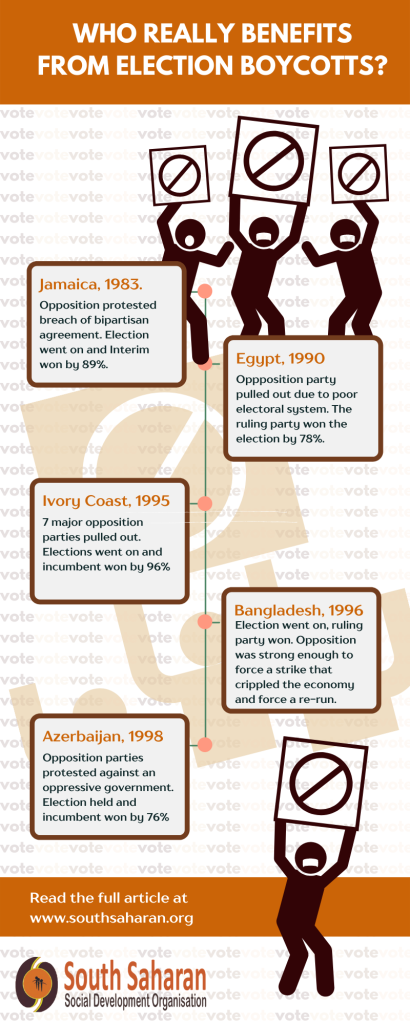
Jamaica, 1983.

The election in 1983 was always a two-horse race between the ruling party, Labour Party, and the People’s National Party. Edward Seaga, the seating Prime Minister at the time was the candidate of the ruling party and former Prime Minister Michael Manley was the leader of the opposition party. Both parties initially agreed the election take place in 1984 when a new voters registration system would be in place. 

This system will allow 180,000 new voters to register. The incumbent on sensing the economic downturn and his diminishing popularity decided to have the election hold months earlier. Mr. Manley crying foul boycotted the election stating a breach of bipartisan agreement. 

Outcome: The election went on and the opposition lost. The interim Prime Minister won by 89%.    

Egypt, 1990.

The four main opposition parties in the country boycotted the election citing cases of rigged elections and reluctance on the part of the government to accept the proposed policies of the opposition parties which include: supervision of election by judges, improvements in accounting for voters, and a suspension of the martial law that has been in place since 1981. The parties stated that unless these policies were adopted, elections will be the same old story. 

Outcome: The ruling party, National Democratic Party won the election by 78%

Ivory Coast, 1995. 

Interim president Henri Bedie in 1994 approved an electoral code that prevents Non-Ivorians from contesting and voting in the 1995 elections. This code automatically ruled out leading opposition aspirant Alassane Ouattara and was also a move that was perceived by the people as one that will destroy national integration. The seven major opposition parties pulled out of the election in protest of the decision. 

Outcome: The election went on and the incumbent won by 96%.  

Bangladesh, 1996.

The country has had a series of boycotts that resulted in the birth of the prominent political parties in the country today. The country’s major opposition party at the time, Awami League, championed the push for the boycott. This was because the government refused to inaugurate a caretaker government ahead of the elections, as was the custom in the country. They did this to prevent interference by the incumbent government in the election outcome. 

Outcome: The election went ahead, which the ruling party at the time, Bangladesh Nationalist Party, won in a landslide victory. However, the opposition parties instigated a strike that crippled the country and resulted in a caretaker government being installed. They conducted elections in June, and Awami League won the election. 

Azerbaijan, 1998.

In Azerbaijan, we also see a case of an election boycott by some political parties who criticize the incumbent government of President Aliev. They claim the government silences its opponent and there have been violations during the pre-election period. There have been reports where the government has jailed journalists, civil society activists, and human rights lawyers.  

Outcome: The election held, and the incumbent won overwhelmingly by 76%.  

Election Boycott is a Bad Strategy

Going by history, we can see clearly that an election boycott has never really resulted in election cancellation or postponement. And only in Bangladesh was the opposition strong enough to cripple the economy that led to an eventual re-run. 

In Iraq in 2005, the Sunnis decided to boycott elections, and this is perceived as one of the greatest strategic blunders in the post-Saddam era. This left them disadvantaged and without a fair share of representation during the formative years of the new Iraq. 

IPOB through this mandatory election boycott would disenfranchise citizens from exercising their rights. Better still, a galvanized approach to push for a candidate who is sympathetic to their cause might be a better approach.  

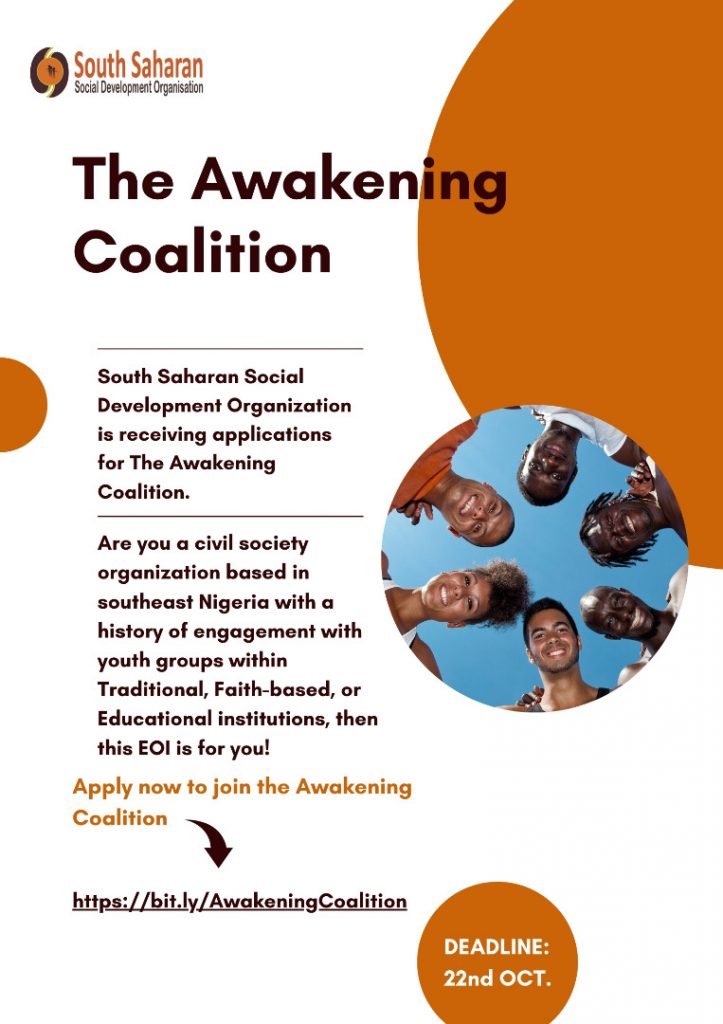
Expression of Interest (EOI): Southeast Awakening CSOs Coalition

South Saharan Social Development Organization (SSDO) is a duly registered non-profit organization in Nigeria, with a primary focus on equipping women youth, and children with the social, health, economic, educational, and political skills needed to survive and compete favorably in a vastly changing and urbanizing sub-Saharan Africa.

SSDO is accepting expressions of interest from youth-led and youth-focused CSOs in the Southeast to form an Awakening coalition. Organizations who have successfully executed projects in the governance space are encouraged to apply, particularly those with verifiable evidence of engaging youth within any of the following institutions/groups:

1. Tertiary Educational Youth Groups/Institutions

2. Faith-Based Youth groups/Institutions

3. Traditional Youth group/Institutions

The Awakening is a youth-focused civic enlightenment program aimed at enlightening young people in the South East on good governance, democratic principles, civic participation, and active citizenship in order to awaken them to their civic responsibility and provoke them into demanding full representation, involvement, and active participation in decision making and governance. Since 2015, the program has engaged youth mainly through the Awakening radio hour on youth-centered radio stations (Dream FM Enugu, Flo FM Umuahia, and Radio Nigeria southeast zonal station) and youth clubs on good governance, civic engagement, and civic education across southeast Nigeria.

ELIGIBILITY CRITERIA

  • CSOs must be based in the South East.
  • Must be youth-led and youth-focused.
  • Must be duly registered with CAC
  • Have a physical office location in southeast Nigeria.
  • Must have worked with either of the following: Tertiary Educational Youth Groups/Institutions, Faith-Based Youth groups/Institutions, Traditional Youth group/Institutions

DEADLINE

All applications should be submitted on or before October 22, 2021.

Apply now to join the Awakening Coalition: