SSDO

PAWED ADVOCACY VISIT TO THE ENUGU STATE MINISTRY OF BUDGET AND PLANNING

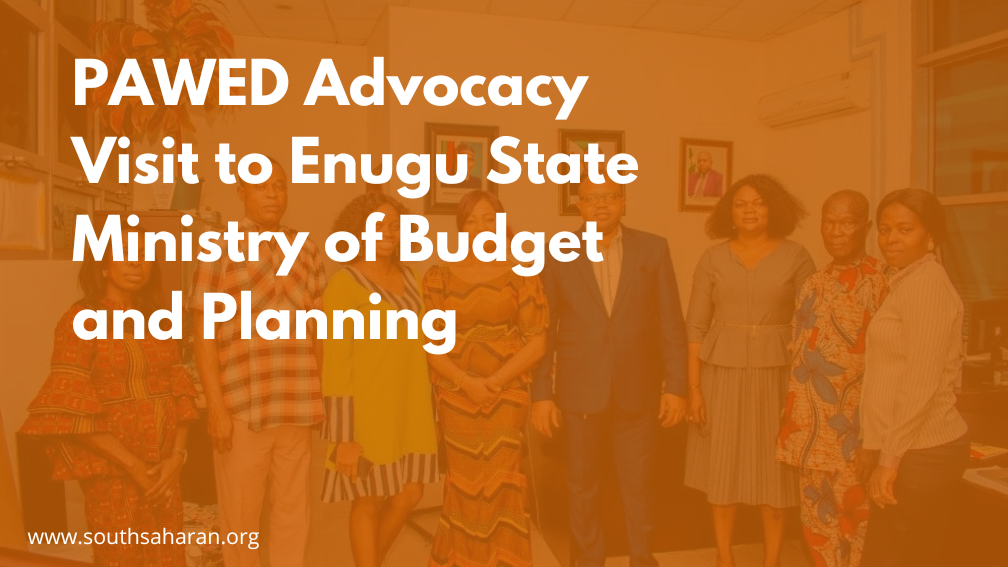
On Thursday, 28th July, members of the PAWED coalition embarked on an advocacy visit to the Enugu State Ministry of Budget and Planning.

Participating in the advocacy visit were:

  • Nkem Awachie (South Saharan)
  • Ozor Modesta (AWITA)
  • Chinasa Onuoha (FIDAN)

The participants were welcomed into the office of the Commissioner and sat down to have a meeting with the following officials present:

  • Hon. Dr. David Ugwunta (Hon. Commissioner for Budget and Planning)
  • Bar. Emeka Ngene (HOD Admin and Supply)
  • Mrs. Clara Eze (HOD Budget)
  • Mrs Okenwa Ndidiamaka (HOD Accounts)

They introduced themselves and the PAWED project. They explained that the advocacy visit came as a follow-up to the recently-concluded policy dialogue session on Women’s Economic Empowerment, which the Commissioner himself had attended.

At the policy dialogue session, several issues surrounding WEE had been discussed, and after deliberations by stakeholders from different sectors, it was decided that the most urgent issue was “low public awareness of existing economic empowerment opportunities“.

The solution to this issue is threefold:

  • to create a publicly-accessible online database of current economic empowerment opportunities
  • to have a robust awareness campaign (especially through radio) for each economic empowerment opportunity created by the government
  • to build the capacity of women in rural areas to be able to apply and partake in avfailable economic empowerment opportunities.

The participants explained that they understood that the Ministry of Budget and Planning was not responsible for creating or implementing projects, but the objective of the advocacy was to:

  • appeal to the Ministry that programs and projects that foster WEE in the state be captured and approved in subsequent government budgets
  • declare readiness to collaborate with the Ministry where necessary in order to make sure that women have a better business environment as well as support and sponsorship from the state government.

The Honorable Commissioner commended the Coalition’s passion in advocating for Women’s Economic Empowerment.

He noted that the state government was already making great strides towards gender equality, and mentioned several government MDAs headed by women, including the Ministry of Finance, Ministry of Special Duties, the Post Primary Schools Management Board (PPSMB), and the Enugu State Waste Management Authority (ESWAMA).

He also called their attention to ongoing economic empowerment programmes by the government but agreed that indeed there is a need for increasing public awareness of existing economic opportunities. He suggested that the coalition should work with MDAs like the Enugu SME Centre or the Ministry of Information to create a program that would fill this need.

He expressed the willingness of his Ministry to work with the coalition and support advances for WEE.
PAWED ADVOCACY VISIT TO THE ENUGU STATE ECONOMIC PLANNING COMMISSION

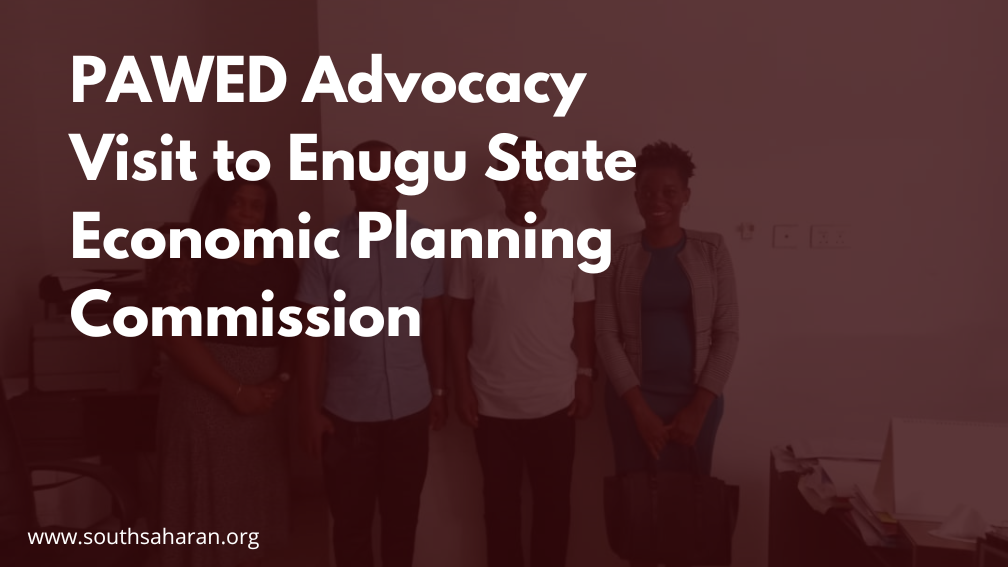
On Thursday, 9th June 2022, members of the PAWED coalition embarked on and advocacy visit to the Enugu State Economic Planning Commission.

Participating in the advocacy visit were:

  • Nkem Awachie (South Saharan)
  • Nebo Collins (New Century Initiative)

The participants were welcomed into the office of the Director and sat down to have a meeting with the following officials present:

  • Mr. Dan Onyishi (The Director)
  • Barr. Ifeoma Chukwurah (Legal Advisor)

The participants introduced themselves and the PAWED project. They explained that the advocacy visit came as a follow-up to the recently-concluded policy dialogue session on Women’s Economic Empowerment.

At the policy dialogue session, one major issue raised was the inadequate budgetary allocations for the implementation of policies and projects for women’s economic empowerment.

Hence, the participants recommended that the Economic Planning Commission:

  • Work to increase the budgetary allocation for the implementation of WEE projects and policies in Enugu State.
  • Ensure that WEE budget items are duly implemented, not rendered ineffective by bureaucratic bottlenecks.
  • Ensure transparency in the awarding of contracts and selection of beneficiaries for WEE projects and policies.

The Director commended the coalition members on their proactive pursuit of Economic Empowerment for women.

He pointed out that the government already has a number of economic schemes and programmes, of which many of the beneficiaries are women. He however, could not immediately provide links to these programs, which indicated a need for an easily accessible online database for government economic empowerment programs and opportunities.

He also mentioned that they had taken steps to facilitate poverty alleviation and socio-economic empowerment of citizens by producing a Social Protection Policy for Enugu State. The Policy represents Enugu State’s adoption and domestication of the National Social Protection Policy, putting in mind the indigenous culture and aspirations of the people. It encompasses measures that could be adopted to enhance the social well-being of the citizens of the State, as well as implementation framework and modalities for effective monitoring.

He however admitted that more could still be done, but that would be within the purview of other Ministries responsible for the direct implementation of economic programs and schemes.

He assured the participants that the Economic Planning Commission is open and proactive, and would be happy to support the push for Women’s Economic Empowerment in Enugu state.

PROJECT 100- Town Criers Engagement Meeting

Having identified a high level of low voter turnout in rural communities, South Saharan Social Development Organization is taking the initiative to execute Project 100-rural election drive in 108 communities across nine LGAs in Enugu state. 

The Project’s LGA coordinators across the nine LGAs have engaged the town criers and duly briefed them on the scope of their assignment. The goal is to sensitize and educate the rural populace on the need to vote, increase PVC collection, and increase voter turnout. 

The selected town criers would engage their communities over a ten-day period, consistently sensitizing the people to pick up their PVCs, where to pick them up, and vote. 

The project would leverage IEC materials (flyers) in strategic places in the community and radio jingles to increase the message’s reach. The message is simple: 

– Get Your PVC 

– Vote 

– Protect Your Vote

SSDO Launches Project 100 – Rural Election Drive

Since the inception of democracy in Nigeria in 1999, voter apathy has continued to rise, with a dwindling number of voters at the polls. This has led to massive disenfranchisement, especially in rural areas.

Nigeria’s rural population makes up 48 percent (99 million) of the nation’s size. Still, the rural community is nowhere to be found when it comes to citizen participation and its resultant effect on governance. 

These communities are characterized by high population density, poor infrastructure, high levels of illiteracy, and extreme poverty. These factors have negatively impacted the ability of the rural population to participate in nation-building. If about half of the country’s population is shut out from the dividends of democracy and its processes, it is safe to say policies and government implementation will have an urbanized rather than a truly national impact.  

However, for any of these pitiful circumstances to change, it starts with citizens’ active participation in the electoral process in rural communities. Understanding the challenge, South Saharan Social Development Organization, SSDO, launched Project 100- Rural Election Drive. The project aims to sensitize and educate rural voters in 100 communities in nine LGAs in Enugu state on the need to exercise their franchise. 

The goal is to increase PVC collection and voter turnout in Enugu state by engaging community town criers to disseminate information. Their proximity and constant access to the people make them an excellent information dissemination channel to reach rural communities. 

On the 11th of November, SSDO organized an engagement meeting with stakeholders to commence the project. SSDO’s Executive Director, Dr. Stanley Ilechukwu, explained, “Nigeria’s socio-economic situation has served a toxic mix of unemployment and a loss of livelihood, impacting harder on those living in impoverished communities. These inadequacies have led them to turn a blind eye to the electoral process, which is the best way they can advocate for a better future.” 

“We understand that change starts by voting, hence the project’s need. To reawaken the consciousness that the economic situation has stifled in the people.”

The overall objective of the project is to:

• To educate and sensitize the rural populace on the need to vote. 

• To improve the expression and participation of the rural populace in the electoral process. 

• To increase PVC collection throughout the month in sensitized communities. 

• To increase voter turnout in the sensitized communities. 

• To provide technical support to rural communities through radio jingles and IEC materials.

Women’s Peer Education Training

Through years of working on projects at the community level, we realize that women and girls are hugely disadvantaged. They have often been marginalized and segregated to the background on so many fronts in society.

One of the primary reasons for marginalization is the inequality between men and women in accessing and controlling resources.

And as such South Saharan Social Development Organization, in partnership with ActionAid Nigeria, seeks to foster women’s empowerment through peer education. This initiative aims to advocate for women’s rights and bridge women’s capacity deficiency at the community level.

The program was facilitated by the Project’s Lead, Perpetual Njoku, SSDO’s Gender Officer, Blessing Uchendu, and SSDO’s Good Governance Lead, Nkem Awachie. The training was executed using the Women Peer Education Resource Kit. 

It covered essential areas such as personal development, hygiene, livelihood, nutrition, and inclusion. The women were taught how to mobilize and organize for collective actions, rights and responsibilities, family and community relationships, and well-being.