SSDO

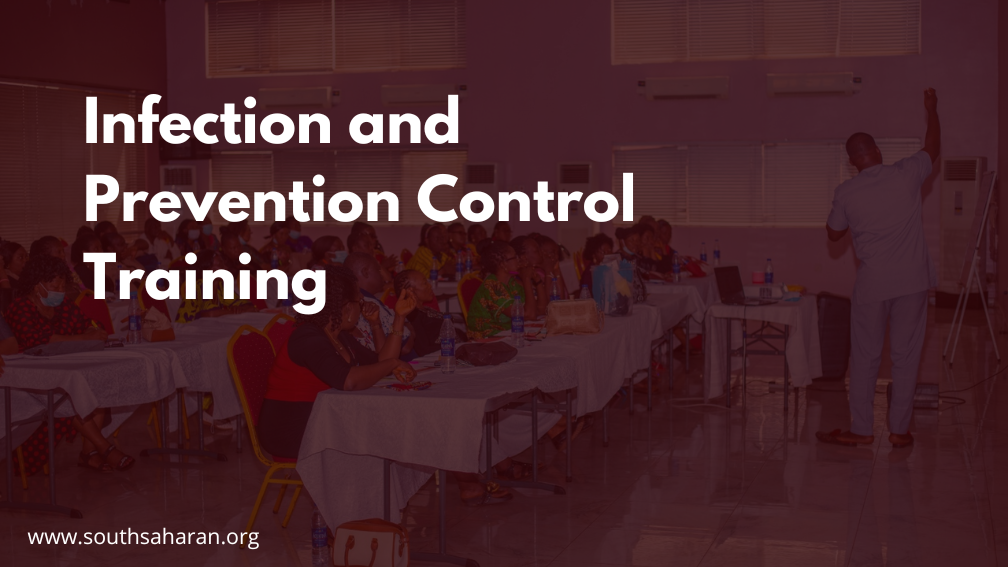
Infection and Prevention Control Training

Healthcare workers are the backbone of an effective healthcare system. Health officials are often front liners providing essential services at the community level. Based on the sensitivity of their jobs, they are frequently exposed to infections and diseases.

Understanding the constant risk healthcare workers are exposed to, WaterAid Nigeria and South Saharan Social Development Organization saw the need to organize a training workshop to strengthen the capacity of about 100 healthcare workers in Enugu State on infection and prevention control (IPC).

The training, which was held on the 19th and 20th of January, 2023, had health officials from different healthcare facilities and agencies in attendance. Three resource persons facilitated the training: University of Nigeria Teaching Hospital IPC specialist Dr. Onyekachi Ugwa, Enugu State Epidemiologist Dr. Ezeudu Chinyere, and Water and Sanitation Hygiene Consultant Jessica Ezeime.

The workshop covered topics such as environmental cleaning and disinfection, disease transmission, and precautions. Participants were better equipped on how to protect themselves and avoid being a source of infection to patients.

SSDO, WaterAid Nigeria Conducts Training for Community-Based Campaign

To support the efforts of the government to halt the spread of infectious diseases such as Diarrhea, cholera, coronavirus, and other WASH-related diseases; and consolidate on the gains and wins from previous projects in Enugu state, WaterAid Nigeria and South Saharan Social Development Organization (SSDO) conducted a practical training on Hygiene Behavior Change.

The training was designed to prepare facilitators for the community-based campaign under the Hygiene Behavior Change Coalition (HBCC) Phase II project. It covered behavior change analysis, theory of change, hand washing, food hygiene, safe use of water, and covid-19 vaccine uptake. A community session manual was used to teach the participants about the best approaches for community entry, program implementation, and creative approaches to achieve behavior change.

OBJECTIVES OF THE TRAINING

  • To acquaint facilitators with WaterAid’s Hygiene Behavior Change Approach
  • To introduce the Clean Family Campaign (Clean family, Happy family), its rituals and themes, as well as the key behaviors the campaign is trying to reinforce through surprises, fun, and exciting, attractive, and engaging games.
  • Train facilitators on the designed HBC intervention package for the HBCC II project and develop plans to roll out the pre-testing of the developed HBC tools in 8 communities in Igboeze North LGA. 
  • Conduct Pre-test intervention package for community events 1,2,3 & 4 in selected communities and Household settings and collate feedback in terms of facilitation and content of the manual.
  • To improve the content of the manual and enhance the facilitation of the community events with information gathered from the events’ pre-testing activities.

The training sessions also focused on the following points.

  • Ensured everyone understands hygiene and its importance.
  • Participants understood that a creative/innovative process is more likely to change behavior.
  • Understood the key elements of the universal behavior change approach.
  • Deliver – implementing the intervention as developed; minimize the difference between the designed ideal intervention and the actual implementation in real life.
  • Community entry strategy and how to implement it according to design
  • Making sessions participatory and interesting for community members

SSDO collaborated with CSO partners who have been part of the HBC implemented in Bauchi State to train the facilitators to have an in-depth understanding of the final HBC Package developed for the HBCC II project to be implemented at community and household levels. The participants were also guided to practically understand the finalized packages through explanations, group simulation/rehearsal, and plenary presentation towards behavior change that will prevent and control the spread of infectious diseases like COVID-19, Diarrhea, Cholera, Lassa fever, among others, and bring dignity.

After the training, participants conducted a pre-test intervention in different communities and households to properly internalize the approach and collect feedback from the communities in a truly participatory monitoring and evaluation process. Participants include members of the Igbo-Eze WASH unit, the State Ministry of Health Epidemiology Unit, the Office of the State Director of Public Health, Primary Healthcare Development Agency, among others. 

The HBCC II project is funded by the Foreign, Commonwealth and Development Office (FCDO) and Unilever to combat new Covid-19 variants through hygiene behavior change, rehabilitation, and construction of Handwashing Facilities (HWFs) and support for increased COVID vaccine uptake in Bauchi and Enugu states.

TERMS OF REFERENCE – RESEARCH CONSULTANT – DECEMBER 2022

SURVEY AND ACTION RESEARCH ON CLIMATE CHANGE, LIVELIHOOD AND YOUNG PEOPLE.

TERMS OF REFERENCE

Background

South Saharan Social Development Organization (SSDO) is a non-profit organization founded in 2001. SSDO works with poor and vulnerable people, with a particular view to equipping young women, youth and children with the educational, political, and social skills needed to survive and compete favorably in a vastly changing and urbanizing sub-Saharan Africa. Our areas of focus include Education, Good Governance and Health.

The SPA II project is a four-year (2022 – 2025) project funded by Danish International Development Agency (DANIDA). The project aims to improve the realization of fundamental human and democratic rights and improved, sustainable livelihoods, resilience and protection for young people, especially young women living in marginalization, including in disaster and protracted crises contexts. 

SPA II is being implemented in 7 states across Nigeria – Borno, Adamawa, Yobe, Enugu, Akwa-Ibom, Abuja, and Lagos.

Enugu has one of the highest concentrations of tertiary institutions and a very high youth population with limited growth opportunities and access to public services.

Enugu’s indigenes and residents are faced with massive youth unemployment, worsening climate conditions, and stretched public services.

The activities of unknown gunmen, kidnappers and secessionist groups have fuelled conflict in the region, leading to weakening structures and protection systems, household vulnerabilities, and displacements.

The humanitarian crises in Nigeria can be viewed as inherently a development crisis of poor governance and poverty. In this situation, young people are increasingly vulnerable to radicalization and violent extremism. Loss of livelihoods is also linked to climate change, as desertification and prolonged droughts are causing conflict over scarce resources. The recession of Lake Chad River has left about 40 million youths restive and exposed to poverty and unemployment.

Climate change is affecting everybody regardless of caste, ethnicity, religion, sex, race, or level of income. Climate change impact has served a toxic mix of high unemployment, loss of livelihood and despondency.

Residents of Enugu State are feeling the impact of climate change in different ways in Enugu state. Early cessation of rainfall and longer dry spells have affected farming and agricultural activities. Farmers have had to readjust the planting season to suit the changing climate. Especially those who cannot afford to implement irrigation programs. This has affected food availability and resulted in scarcity.

There has also been an increase in temperature and a persistent surge of heat waves across cities, especially during the dry season. These heat waves have a costly effect on health and agriculture. It has led to an increase in heat stroke, dehydration, heat rashes, and meningitis. Flooding and erosion are also clear indicators of the impact of climate change in Enugu state.

Other factors causing poverty for young people and particularly young rural women, include skills gaps, limited economic opportunities, restrictive and discriminatory economic policies.

Addressing the multiple inequalities and disproportionate impacts faced by young people, and marginalized communities must be central to addressing climate induced loss and damage. However, most analysis, policies and interventions related to climate change and livelihood fail to consider the youth lens especially that of young women.

As part of SPA II climate change objectives, we are conducting research to understand young people’s perceptions on the effects of climate change on their livelihoods. And specifically, to assess the effect of climate change to their livelihood activities and identifying mitigation or adaptation measures against the effects of climate change on young people’s livelihood activities.

Objectives of the Study

The broad objective of the study is to get in-depth context knowledge and to understand young people’s perceptions on the effects of climate change on their livelihoods.

Specifically, to:

  • Identify the livelihood options of young people especially young women within specific LGAs in Enugu state- Aninri, Isiuzo, Igboeze North and Enugu North.
  • Assess the effect of climate change to their livelihood activities
  • Identify mitigation or adaptation measures against the effects of climate change on young people’s livelihood activities.
  • Establish the linkage between climate change, young people and livelihood, challenges, and framework for engagement through public expenditure processes (budgeting)
  • To determine the frequency with which climate change occur and how it affects livelihood of young people.
  • To gain new insight into the issue of climate change, livelihood, and young people.

Research Methodology

Literature Review: The research will involve a qualitative review of the latest grey and academic literature on youth, gender and climate resilience and adaptation. Other publications and documentation will also be reviewed.

Primary data collection

Building on this literature review qualitative primary research (Focus Group Discussions and Key Informant Interviews) will be carried out within selected LGAs in Enugu State (Aninri, Isiuzo, Igboeze North and Enugu North) on assessing the impact of climate change on young people’s livelihood.

Analysis and Outputs

Analysis of the findings will be written up into a detailed report that also explains the methodology used and the shortcomings of the research. A further output will be a shorter policy brief that will be used for the purpose of advocacy and policy influencing within the subnational and national levels in addressing the problems identified from the research

Overview of the Consultancy

The consultant would lead this research project from start to finish. The consultant would carry out the literature review, work with SSDO team to refine the research questions, develop-out the methodology and carry-out the data collection. He would also lead the writing of the report and provide the policy brief.  The consultancy would take place over 10 days from 6th to 19th December 2022.

Expected Deliverables

The consultant is expected to deliver the following outputs with key process elements included in the timeline and outputs below:

  • Literature Review
  • Methodology for the research
  • Conduct the data collection, validate data, and present it in the format as given by SSDO
  • Analyze survey data and present findings in tables, graphs, and presentation
  • Analysis report of findings and comprehensive list and findings of the survey showing the impacts of climate change on young people and livelihood within the selected LGAs in Enugu State.
  • Policy brief
  • Report should be submitted in hard and a soft copy on an external hard drive or Hard disk, it should also contain relevant documentation including video clips, quality photographs, links for reference purposes and any other material produced/documented during the fieldwork investigation
  • Write report and make recommendations based on the research findings.
  • Produce an advocacy tool on climate change and livelihood to be utilized for stakeholders’ engagement

Qualifications and Criteria for Selection  

The Consultant is expected to have the following qualifications: 

  • Minimum of master’s degree in social sciences, international development, statistics, or any other relevant field
  • At least 7 years experience in research and youth analysis and excellent knowledge of the development sector and humanitarian programmes including terminology
  • Experienced in conducting research using qualitative and quantitative data collection methods as well as coordinating and training data collectors
  • Experienced in contextualizing and elaborating counting methodologies and data collection processes and tools.
  • Excellent facilitation, writing, and reporting skills 
  • Computer literate and able to apply Microsoft Office and other analytical tools efficiently 
  • Excellent communication and interpersonal relation skills 

Contact Details

For more details or to submit your expression of interest, please send an ‘Expression of Interest letter indicating your current rate, along with an up-to-date CV, to the email – hr@southsaharan.org

Deadline for Applications

All applications should be submitted on or before the 6th of December, 2022.

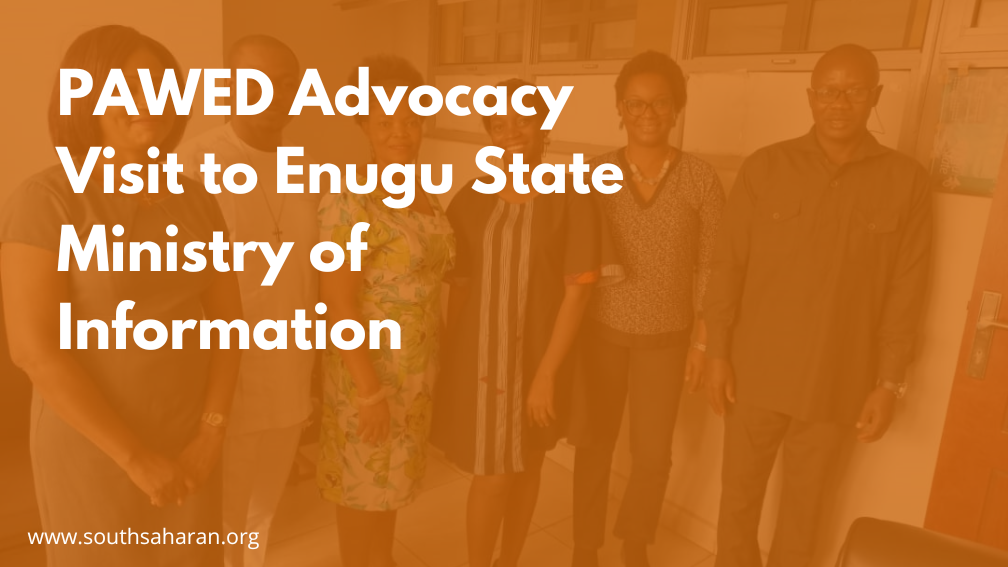
PAWED ADVOCACY VISIT TO THE ENUGU STATE MINISTRY OF INFORMATION

On Wednesday, 3rd August 2022, members of the PAWED coalition embarked on an advocacy visit to the Enugu State Ministry of Information.

Participating in the advocacy visit were:

  • Nkem Awachie (South Saharan)
  • Ozor Modesta (AWITA)
  • Nebo Collins (New Century Initiative)
  • Chinyere Otuonye (Empowered to Empower Multipurpose Cooperative Society)

The participants were welcomed into the office of the Commissioner and sat down to have a meeting with the following officials present:

  • Mrs.Ugochukwu Adimora (Head of Department)
  • Ugwu Joe (Principal Executive Officer)

The participants introduced the PAWED project to the HOD, and explained that the advocacy visit came as a follow-up to a recently-concluded policy dialogue session on Women’s Economic Empowerment, to which various WEE stakeholders had been invited.

At the policy dialogue session, several issues surrounding WEE had been discussed, and after deliberations by stakeholders from different sectors, it was decided that the most urgent issue was “low public awareness of existing economic empowerment opportunities.”

The solution to this issue is threefold:

  • to create a publicly-accessible online database of current economic empowerment opportunities
  • to have a robust awareness campaign (especially through radio) for each economic empowerment opportunity created by the government
  • to build the capacity of women in rural areas to be able to apply and partake in available economic empowerment opportunities.

The participants explained to the HOD that the Ministry of Information had been picked for this advocacy because they would be best positioned to receive data and information from all the state MDAs, and they are already in charge of disseminating information about Enugu state government activities.

The HOD thanked the participants for visiting and making recommendations but pointed out that Enugu state government already has an active website where they report news of all government activities and projects.

The participants explained that this advocacy request was not for the establishment of a general government website, but rather a separate website focused on economic empowerment where women and youths could go look for government-sponsored economic opportunities, without having to sift through tons of news reports about other government activities.

The HOD was open to the suggestion and asked for further ideas for the website. The participants suggested that the website should be searchable via different filters including type of opportunity, location, and responsible MDA. They also suggested that the website should have a section for non-governmental opportunities.

The HOD said she was on board with the suggestion and would raise it with other government officials, but was not making any promises, as the approval process could be very long and convoluted.

The participants thanked her and expressed the willingness of the PAWED coalition to provide partnership and support in the project creation and implementation.

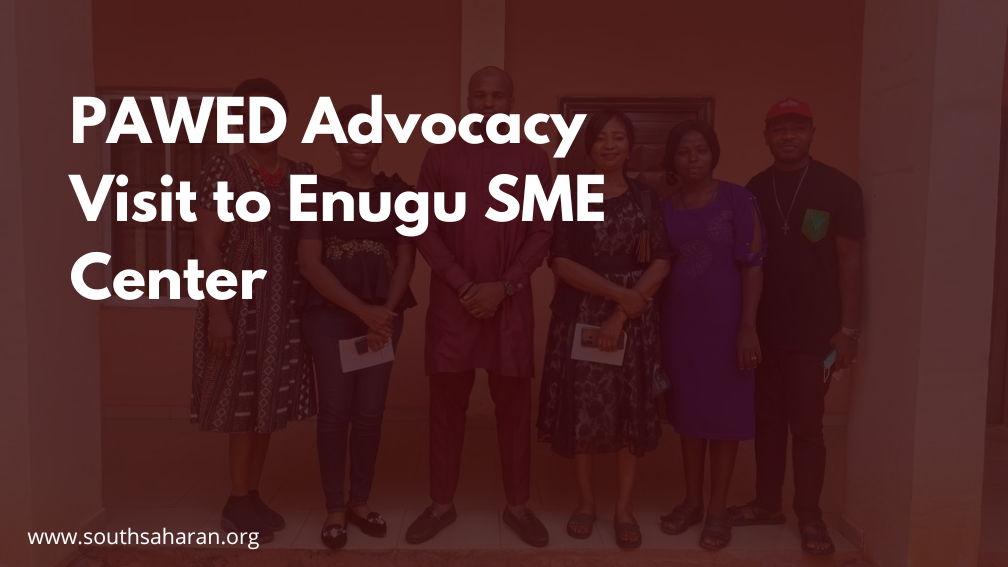
PAWED ADVOCACY VISIT TO THE ENUGU SME CENTRE

On Friday, 29th July, members of the PAWED coalition embarked on an advocacy visit to the Enugu SME Agency.

Participating in the advocacy visit were:

  • Nkem Awachie (South Saharan)
  • Ozor Modesta (AWITA)
  • Nebo Collins (New Century Initiative)
  • Chinyere Otuonye (Empowered to Empower Multipurpose Cooperative Society)
  • Jessica Ezieme (South Saharan)
  • Chinasa Onuoha (FIDAN)

The participants were welcomed into the office of the Director- Arinze Chilo-Offiah. They introduced the PAWED project to him and explained that the advocacy visit came as a follow-up to a recently-concluded policy dialogue session on Women’s Economic Empowerment, to which he had been invited.

At the policy dialogue session, several issues surrounding WEE had been discussed, and after deliberations by stakeholders from different sectors, it was decided that the most urgent issue was “low public awareness of existing economic empowerment opportunities“.

The solution to this issue is threefold:

  • to create a publicly-accessible online database of current economic empowerment opportunities
  • to have a robust awareness campaign (especially through radio) for each economic empowerment opportunity created by the government
  • to build the capacity of women in rural areas to be able to apply and partake in available economic empowerment opportunities.

The participants informed the Director that the SME Centre had been pinpointed as a worthy MDA to undertake the creation of the online database for current economic empowerment opportunities. Due to the fact that the SME Centre is already focused on economic empowerment and has an active website and online presence, which is indicative of the fact that they have the know-how to implement this solution.

The Director informed the participants that they already had programs which they had implemented, but would not be able to handle a central online database for economic opportunities, as they did not have that information.

He hinted at the fact the upcoming change in government might affect the willingness of current office holders to start new projects, but he offered to share a brochure of the SME Centre’s projects.

The participants thanked him, and the visit came to an end.