SSDO

SSDO Organizes High-Level Meeting To Tackle Exploitative Child Domestic Work In South East Nigeria

Research by The Freedom Fund shows that 89% of children work in conditions that violate one or more of the Child Rights Act and 35 % enter domestic work before the age of 10. Studies from the International Labour Organization also show that Southeast Nigeria has the highest percentage of child labour in the country at 49.9 %. All these further indicate how serious this challenge is and the need to take action. 

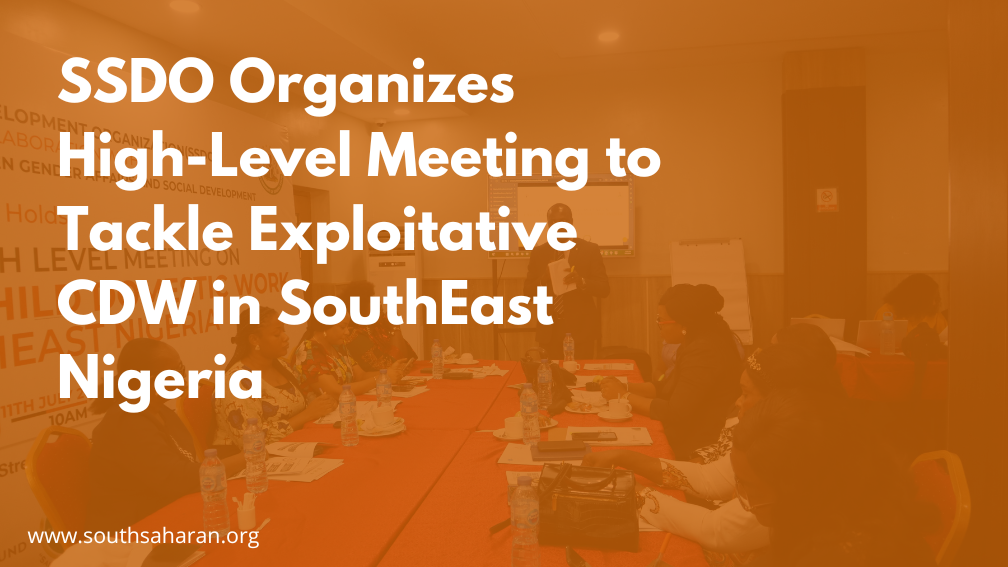
Understanding the severity of this issue, South Saharan Social Development Organization, SSDO, in collaboration with the Enugu State Ministry of Children, Gender Affairs, and Social Development organized a high-level meeting to tackle exploitative child domestic work in southeast Nigeria. 

The meeting was an avenue to discuss actionable solutions and develop a structured framework for interstate collaboration on exploitative child domestic work and broader child protection measures.

The meeting saw key stakeholders including Commissioners of Gender, Police, Justice, and State House Committee Chairmen on Gender from states around the southeast deliberate and proffer solutions to curbing exploitative Child Domestic Work in the region. 

There was also a breakout session that enabled participants to brainstorm solutions that will be developed into a communique and form a road map for improved care for children. 

Aside from the research listed above that formed the basis for the conversation, SSDO also unveiled its research work, “Child Domestic Work in Southeast Nigeria: Legal Frameworks and Policy Recommendations” which highlighted flaws in legislations and marquee areas for capacity strengthening especially in the judicial sector regarding CDWs in southeast Nigeria. 

Success Stories: Empowering Enugu Farmers Through Agroecology

Across the globe, there’s a growing recognition of the vital role sustainable agriculture plays in tackling key issues like food security, climate change, and rural development. This emphasis is especially pertinent in Africa, where agriculture is the backbone of many livelihoods. With its abundant agricultural potential, Nigeria grapples with challenges such as low productivity, the adverse effects of climate change, and limited financial access for smallholder farmers.

Research shows that agriculture contributes about 25 percent to Nigeria’s GDP and employs nearly 70 percent of the country’s population. However, farmers still struggle with low productivity, the adverse effects of climate change, and limited financial access for smallholder farmers. This isn’t any different in Enugu state as farmers are plagued by limited resources and access to financial services, making it even more challenging for farmers to adopt sustainable farming practices.

The challenge of limited access to finance presents a significant obstacle for smallholder farmers aiming to adopt and maintain agroecological practices. The Central Bank of Nigeria reports that 36% of Nigeria’s adult population has access to formal financial services. This financial exclusion significantly limits farmers’ ability to invest in quality inputs, sustainable technologies, and essential equipment needed for agroecology.

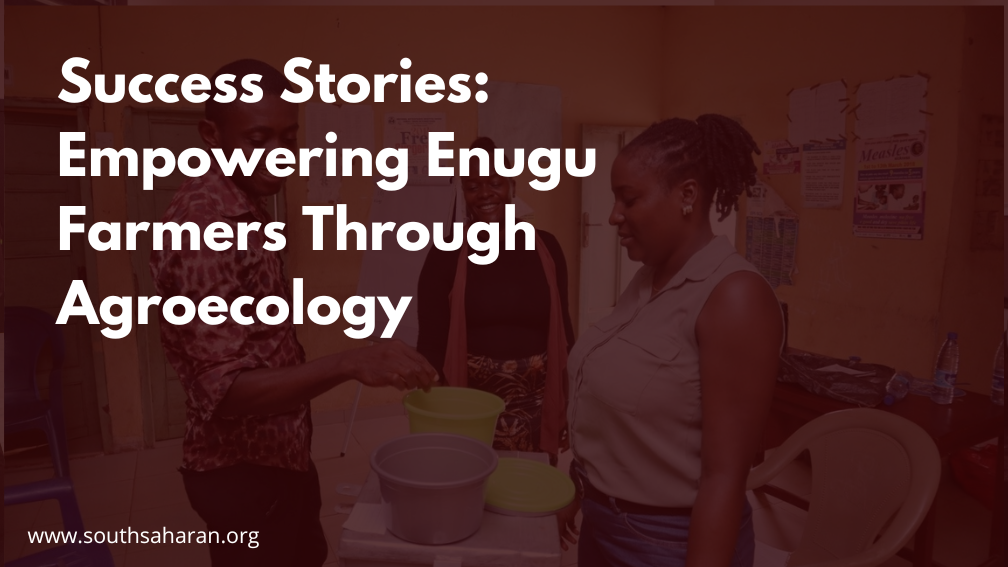
South Saharan Social Development Organization with support from ActionAid realizing this gap, established Village Savings and Loans Association, VSLA, in its three project communities: Umuogili, Oduma Achara, and Ihenyi to support young farmers. VSLA empowers farmers by offering a structured platform for savings, borrowing, and investment within their community.

Mrs. Lucy Odo, the Chairperson for Ihenyi VSLA group shared, “I am grateful to SSDO and ActionAid for this initiative. Getting loans from the bank is a long process for us, especially considering the distance. But with VSLA, I can access loans to start a poultry business.”

The groups have successfully drafted their constitution, ensuring structured and efficient operations. This includes membership criteria, savings and loan procedures, interest rates, repayment schedules, and conflict resolution mechanisms has also been clarified. The associations have collectively saved N375,000 since their inception and six people have accessed loans, a testament to their functionality and effectiveness in mobilizing local financial resources for agri-business.

“I have been wanting to expand my farm and cultivate more land to include new crops but funds have been a limiting factor. Now, I will be able to grow my business and increase my annual income.” Meschach Ayogu from Umuogili community shared. 

SSDO Hosts Strategic Partnership Agreement II Project Donors

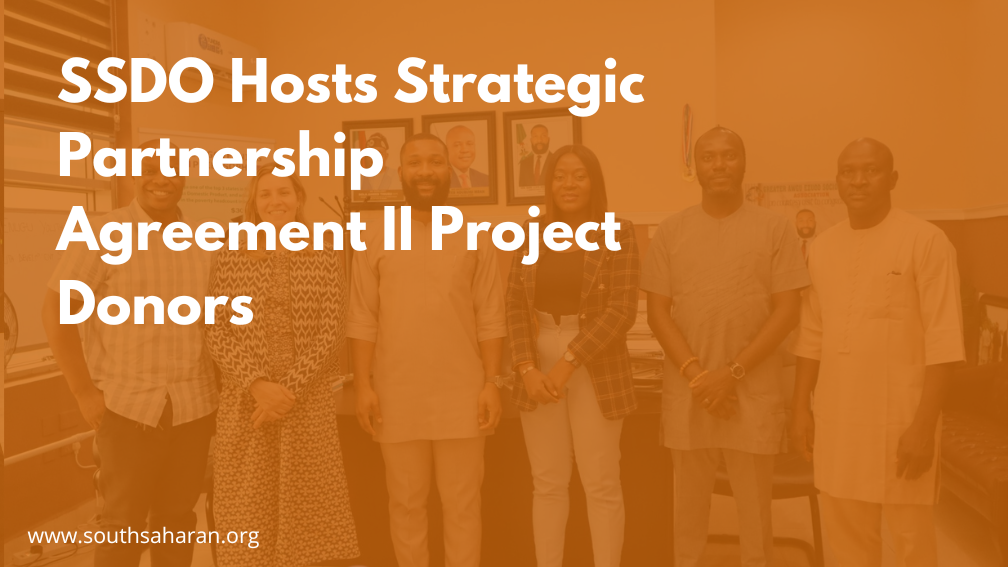
Over two impactful days, the South Saharan Social Development Organization (SSDO) welcomed its esteemed donors from ActionAid Nigeria and Mellemfolkeligt Samvirke / ActionAid Denmark. The visit was a significant opportunity to discuss our ongoing efforts around youth empowerment, climate change, and good governance, and to review the progress of the Strategic Partnership Agreement II (SPA II) project.

Day 1: Discussions on Youth, Climate Change, and Good Governance

On the first day, our donors were warmly received, marking the beginning of insightful discussions about our work and the broader context in which we operate. 

The conversations centered on youth engagement, climate change initiatives, and the promotion of good governance. This initial meeting was crucial for aligning our objectives and ensuring that our efforts are impactful and sustainable.

Day 2: Empowering Youths and Strengthening Collaborations

The second day was equally dynamic and enriching. Our donors engaged directly with youths from various project communities. These young individuals enthusiastically shared how the SPA II project has expanded their perspectives and empowered them to take decisive actions in areas such as budget tracking, project monitoring, advocacy, and climate change initiatives. 

This interaction highlighted the tangible benefits of the project and provided a platform to share learnings and identify areas for enhanced program effectiveness.

In addition to engaging with the youth, the team also had the opportunity to meet with key government officials. Visits to the Commissioner for Youth and Sports, Barr. Lloyd Ike Ekweremadu Jr., and the Commissioner for Environment, Professor Sam Ugwu, allowed for in-depth discussions about their work and policies that can benefit youth and bolster climate change responses in Enugu State. 

These meetings were instrumental in fostering improved collaboration and exploring ways to leverage favorable policies for greater impact.

Moving Forward

The two-day visit was a testament to the strong partnership between SSDO, ActionAid Nigeria, and ActionAid Denmark. It underscored our shared commitment to empowering youth, addressing climate change, and promoting good governance. The insights gained and connections strengthened during these days will undoubtedly contribute to the continued success and effectiveness of the SPA II project.

We extend our heartfelt thanks to our donors for their unwavering support and dedication. Together, we are making significant strides towards a more empowered and sustainable future for the youth and communities we serve.

SSDO Organize Green Skills Boost Workshop 

Plastic waste is a growing global concern, with millions of tons of plastic ending up in landfills, oceans, and the environment annually, with an estimated 300 million tons of plastic produced annually, half of which is designed for single use. 

In Nigeria, 32 million tons of waste are generated annually, of which 2.5 million tons are plastic. In Enugu State, plastic waste is a significant contributor to environmental pollution, clogging waterways, and posing health risks to communities.

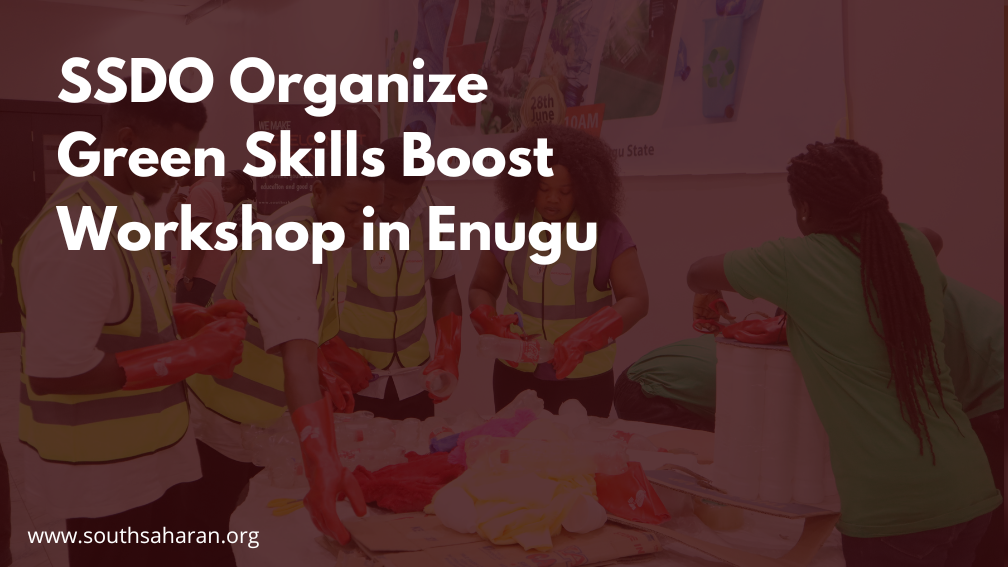
Understanding this challenge and the need to remediate it, South Saharan Social development Organization in partnership with ActionAid Nigeria organized a Green Skills Boost Workshop and Internship program. The initiative aims to address the dual challenge of youth unemployment and environmental degradation. 

The training equipped youths with relevant knowledge on how to venture into the plastic recycling and upcycling sector. Youths were enlightened on the entire plastics waste-to-wealth value chain and how best to identify where they fit in. 

By training youth in the plastics/rubber recycling and upcycling value chain, the program not only provides them with viable economic opportunities but also contributes to the reduction of plastic waste in Enugu state. 

The workshop was facilitated by Ogechi Nwonye-Bernard, a plastic waste-to-wealth practitioner, and founder of Ecocyclers, Mr. Nnamdi Arum, Director of Climate Change, Ministry of Environment, and Udochukwu Egwim, SSDO Head of Programs. 

Participants were engaged using a combination of lectures, practical and interactive sessions, and DIY method. To guarantee the sustainability and impact of the initiative, participants will be placed on a one-month internship program with recycling and upcycling companies in Enugu state. 

A Mother’s Resilience: Juliet’s Journey to Reunite with Her Children

Gender-based violence (GBV) remains a pervasive issue in Nigeria, affecting countless women and girls across the country. Despite ongoing efforts to combat this scourge, many continue to suffer in silence, enduring physical, emotional, and psychological abuse. The effects of GBV on victims are profound, often leading to long-term trauma, health complications, and a pervasive sense of fear and helplessness. In addition to the immediate harm inflicted, victims frequently face societal stigmatization, further isolating them and complicating their paths to recovery and justice.

In the face of such adversity, the story of Juliet Ngene stands out as a poignant example of resilience and the transformative power of dedicated support systems. Juliet, a mother of five, endured relentless abuse and unfounded accusations from her husband. Her journey, marked by separation from her children and prolonged suffering, highlights the critical role that organizations like the South Saharan Social Development Organization (SSDO) and the National Agency for the Prohibition of Trafficking in Persons (NAPTIP) play in supporting victims of GBV. 

Through their efforts, Juliet was ultimately reunited with her children, showcasing a powerful narrative of hope and recovery amidst the pervasive issue of gender-based violence in Nigeria.

Juliet Ngene is a devoted mother of five and is a tailor. Her husband who is supposed to be the family’s breadwinner is a bricklayer, whose job is seasonal. To make ends meet and support her family, she travels to Onitsha to buy materials which she resells in Enugu. From her proceeds, she caters to feeding and also pays the house rent. Sometimes, she also loans her husband money to help him sort out other bills. 

Things took a harrowing turn when Juliet’s husband’s attitude changed towards her. He became abusive and leveled unfounded accusations against her. 

Due to the nature of her job, she had to make several trips to purchase materials. And as a result on some occasions won’t be able to make it back home. On those occasions, she’d stay with her sister in Onitsha.

“He kept accusing me of sleeping with other people. And he knows I have to make those trips to support the family. I will explain myself to him and that in itself will be a precursor for slaps and heavy beatings,” 

“I have told him that anytime I can’t make it home I’d stay at my sister’s, then come to Enugu the next day. That didn’t seem to help. If I come home late due to the distance, he would insult me that I have gone out with my lovers. I couldn’t do anything right in his eyes,” 

 “No matter what I said, he never believed me. Going home after work became a nightmare,” she shared. His accusations were a pretext for driving Juliet out of their home in Enugu.

The husband reported the case to the kinsmen who summoned the wife and her sister to the meeting. She gave her side of the story which the elders fact-checked with the sister. Despite her honest explanations and the corroboration from her sister, who confirmed she stayed with her during late returns from business trips, her husband remained unyielding. 

Desperate to sever ties, Juliet’s husband took drastic measures. He seized control of the properties, most of which Juliet had purchased, and took their children away. He dispersed the children among his relatives, sending three to Abuja and the two girls, Blessing, 16, and Divine, 11, to his sister in Ngwo, Enugu. For months, Juliet was cut off from her children, unable to contact them or ensure their well-being.

Lost and confused, she decided to visit her husband’s village to complain about his actions. And to also make inquiries and find out where are kids are But this yielded no results.  

Determined to reunite with her children, Juliet traveled to Ngwo upon learning that two of her children were there. What she found was heartbreaking: her daughters were malnourished and poorly cared for. When she attempted to take them with her, her husband threatened her, stating, “If I ever see you close to this place, I will deal with you.”

To worsen matters, she realized that her husband’s sister who had custody of the girls sent one to go and live with someone else in Anambra. SSDO’s Gender Officer discovered this while interviewing the older girl Blessing, “I would have run away from my aunt’s house, but I couldn’t because I didn’t know where my sister was taken to. I was scared and worried for her.” 

Despite the threats, Juliet persisted. Her search for assistance led her to SSDO. The Gender Protection Lead at SSDO connected her with NAPTIP, and together they began the arduous process of reuniting Juliet with her children. By May 23, their relentless efforts bore fruit, and custody of her children was restored to Juliet. 

Juliet’s prolonged struggle was exacerbated by her health issues, which left her bedridden and unable to search for her children sooner. “I was very ill and couldn’t move for days. It was only after my recovery that I could start looking for my children,” she explained.

After two grueling years of separation, malnourishment, and emotional pain, Juliet was finally reunited with her daughters, thanks to the unwavering support of SSDO and NAPTIP. Overwhelmed with gratitude, Juliet expressed, “I cannot appreciate SSDO enough for their efforts. Only God can repay you back. I am very happy and grateful.”

Juliet Ngene’s story underscores the critical role of organizations like SSDO in combating gender-based violence and advocating for the rights and well-being of vulnerable individuals. Her journey from despair to reunion is a powerful reminder of the resilience of the human spirit and the profound impact of compassion and advocacy in transforming lives.