Menu
About Research
Introduction
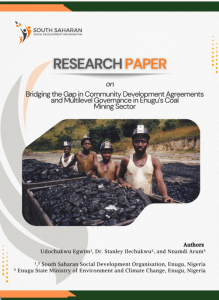
This paper builds on earlier research to examine how Community Development Agreements (CDAs) are implemented in Enugu State’s solid minerals sector, using Awhum in Udi LGA as a case study. Field visits, document reviews, and interviews with officials, civil society, and community members reveal that CDAs are often absent, informal, or poorly enforced, with little state or local oversight. Recent company-community agreements were reactive responses to protests rather than proper CDA processes, and promised benefits like a hospital remain unfulfilled.
The study highlights weak participation, limited transparency, and low accountability, recommending legal reforms, public disclosure of CDAs, and community-led monitoring to ensure meaningful local benefits.

Background and Literature Review
Coal mining shaped Enugu’s economy for over a century but declined due to labour unrest, the rise of oil, and the Civil War, leaving lasting social and environmental impacts. The Minerals and Mining Act (2007) requires Community Development Agreements (CDAs), yet enforcement is weak and many agreements remain informal. Communities often lack legal support and understanding, while oversight bodies like MIREMCO are largely inactive. As a result, benefits are limited, transparency is low, and governance gaps persist.
Research Methodology
This study uses a qualitative case study approach focused on Awhum and Nsude in Udi LGA, where coal mining has recently resumed. Data was collected through seven key informant interviews with government officials, community members, civil society actors, and federal representatives. Interview themes covered how agreements were made, state involvement, and community responses. A review of legal documents, government statements, company releases, and media reports complemented the interviews. Formal CDA documents were not provided, reflecting continued opacity in the sector. Data was analyzed thematically and compared with the Minerals and Mining Act (2007). Limitations included community fear of retaliation and limited awareness of agreement details.
Key Findings
01
CDA Signed Without Awareness
- The CDA between Millhouse Energy and Awhum was signed without state involvement, legal advice, or full community consultation. Many residents misunderstood the agreement, leading to mistrust once mining intensified.
02
Community Revolt and State Intervention
- When residents discovered the high volume of daily coal evacuation, they protested. This pushed the state to mediate, leading to revised company promises such as a hospital project—though no formal revised CDA has been disclosed.
03
Limited Government Knowledge
- State ministries showed weak understanding of CDA requirements under the Mining Act. Officials were unsure of their roles, highlighting a major enforcement and capacity gap.
04
Environmental and Health Concerns
- Mining continues to cause erosion, runoff, and other environmental risks. No publicly available EIA or remediation plan has been shared, despite legal requirements.
05
Broken or Unclear Revenue Commitments
- Although the company committed to payments to the state and community, most residents were unaware of the ₦20,000 per truck community share. There is no audit trail or transparency, creating significant mistrust.
Discussions
Historical Trust Deficit
Decades of extraction with little benefit have left communities distrustful of government and mining companies. This history shapes how new CDAs are received.
Weak and Poorly Understood CDAs
CDAs were signed with limited consultation or legal guidance. Many residents only understood the scale of mining after operations expanded, triggering protests.
Unclear State Role
State intervention has been mostly reactive. With no clear legal framework and an inactive MIREMCO, oversight remains weak.
Limited Community Agency
Communities lack legal support, information, and safe channels to express concerns, reducing their ability to negotiate or hold companies accountable.
Missed Opportunity for Inclusive Development
Payments and promised projects lack transparency and legal backing. Without structured oversight and public disclosure, development benefits remain uncertain and uneven.
Recommendations
Enact a State CDA and Mining Law
The Enugu State House of Assembly should pass a binding law defining the rights and obligations of communities, companies, and the state. The law should require:
Mandatory community consultation and legal review
Clear obligations, penalties, and timelines
Public disclosure of all CDAs
Formal dispute-resolution procedures
This law should align with the Minerals and Mining Act (2007) but strengthen state-level enforcement.
Strengthen MIREMCO Through a Multi-Stakeholder Committee
Enugu State should activate and empower MIREMCO to monitor and enforce CDA implementation. Membership should include government agencies, community representatives, CSOs, mining companies, and independent experts. The committee should conduct regular site inspections and publish annual compliance reports.
Build Community Legal and Negotiation Capacity
Communities need independent legal support and training to negotiate effectively. This includes:
Legal advisory support during negotiations
Training on mineral rights, environmental law, and financial literacy
Formation of Community Monitoring Units to track extraction and compliance
These activities should be supported by CSOs and state agencies.
Dedicate a Fixed Share of Mining Revenue to Community Development
A portion of mining revenue should fund long-term, community-led projects through a transparent Community Development Fund. Key actions include:
Public financial dashboards tracking payments and project spending
Community participation in project selection
Regular audits and clear reporting
This ensures benefits are visible, accountable, and aligned with long-term development priorities.