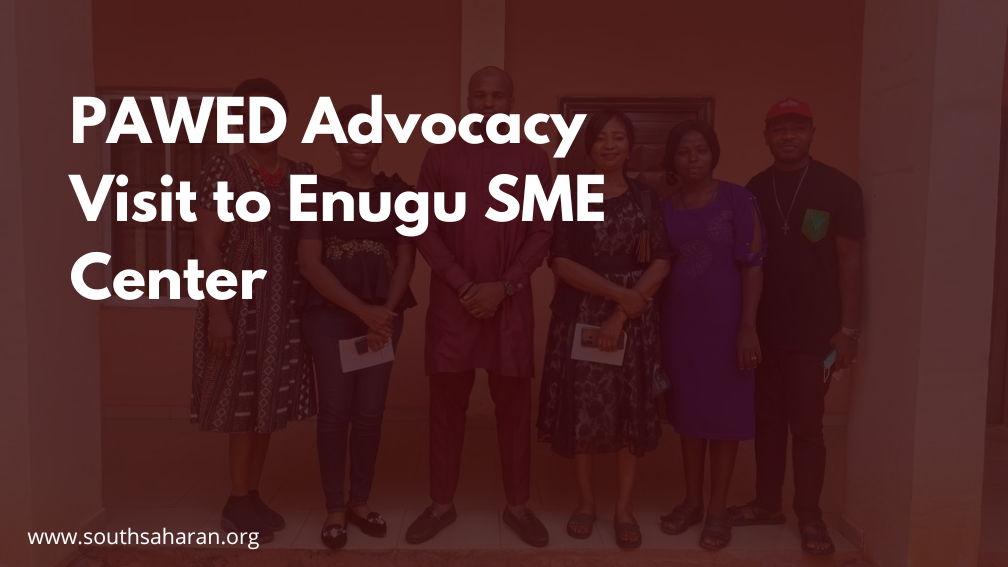
On Friday, 29th July, members of the PAWED coalition embarked on an advocacy visit to the Enugu SME Agency.
Participating in the advocacy visit were:
Nkem Awachie (South Saharan)
Ozor Modesta (AWITA)
Nebo Collins (New Century Initiative)
Chinyere Otuonye (Empowered to Empower Multipurpose Cooperative Society)
Jessica Ezieme (South Saharan)
Chinasa Onuoha (FIDAN)
The participants were welcomed into the office of the Director- Arinze Chilo-Offiah. They introduced the PAWED project to him and explained that the advocacy visit came as a follow-up to a recently-concluded policy dialogue session on Women’s Economic Empowerment, to which he had been invited.
At the policy dialogue session, several issues surrounding WEE had been discussed, and after deliberations by stakeholders from different sectors, it was decided that the most urgent issue was “low public awareness of existing economic empowerment opportunities“.
The solution to this issue is threefold:
to create a publicly-accessible online database of current economic empowerment opportunities
to have a robust awareness campaign (especially through radio) for each economic empowerment opportunity created by the government
to build the capacity of women in rural areas to be able to apply and partake in available economic empowerment opportunities.
The participants informed the Director that the SME Centre had been pinpointed as a worthy MDA to undertake the creation of the online database for current economic empowerment opportunities. Due to the fact that the SME Centre is already focused on economic empowerment and has an active website and online presence, which is indicative of the fact that they have the know-how to implement this solution.
The Director informed the participants that they already had programs which they had implemented, but would not be able to handle a central online database for economic opportunities, as they did not have that information.
He hinted at the fact the upcoming change in government might affect the willingness of current office holders to start new projects, but he offered to share a brochure of the SME Centre’s projects.
The participants thanked him, and the visit came to an end.
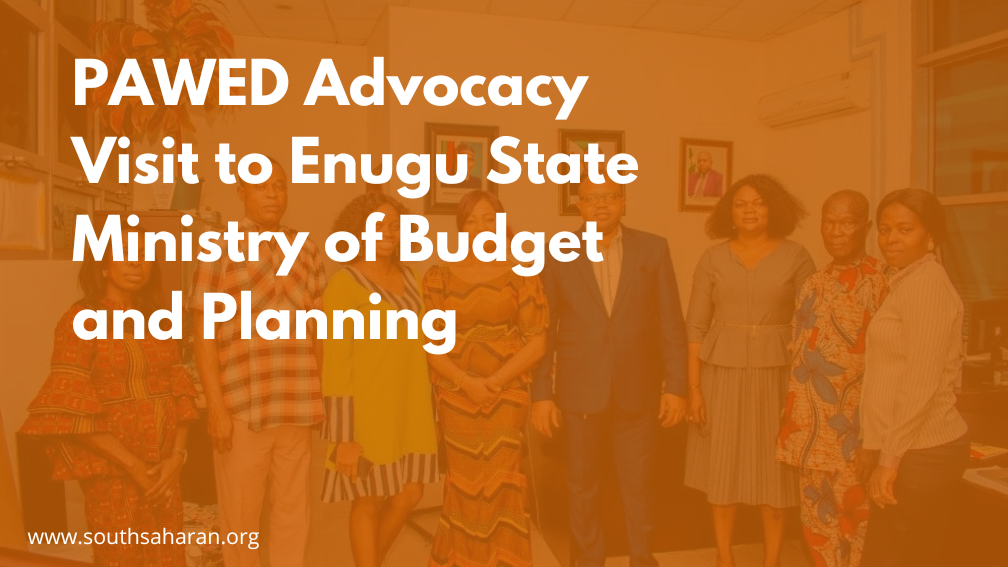
On Thursday, 28th July, members of the PAWED coalition embarked on an advocacy visit to the Enugu State Ministry of Budget and Planning.
Participating in the advocacy visit were:
Nkem Awachie (South Saharan)
Ozor Modesta (AWITA)
Chinasa Onuoha (FIDAN)
The participants were welcomed into the office of the Commissioner and sat down to have a meeting with the following officials present:
Hon. Dr. David Ugwunta (Hon. Commissioner for Budget and Planning)
Bar. Emeka Ngene (HOD Admin and Supply)
Mrs. Clara Eze (HOD Budget)
Mrs Okenwa Ndidiamaka (HOD Accounts)
They introduced themselves and the PAWED project. They explained that the advocacy visit came as a follow-up to the recently-concluded policy dialogue session on Women’s Economic Empowerment, which the Commissioner himself had attended.
At the policy dialogue session, several issues surrounding WEE had been discussed, and after deliberations by stakeholders from different sectors, it was decided that the most urgent issue was “low public awareness of existing economic empowerment opportunities“.
The solution to this issue is threefold:
to create a publicly-accessible online database of current economic empowerment opportunities
to have a robust awareness campaign (especially through radio) for each economic empowerment opportunity created by the government
to build the capacity of women in rural areas to be able to apply and partake in avfailable economic empowerment opportunities.
The participants explained that they understood that the Ministry of Budget and Planning was not responsible for creating or implementing projects, but the objective of the advocacy was to:
appeal to the Ministry that programs and projects that foster WEE in the state be captured and approved in subsequent government budgets
declare readiness to collaborate with the Ministry where necessary in order to make sure that women have a better business environment as well as support and sponsorship from the state government.
The Honorable Commissioner commended the Coalition’s passion in advocating for Women’s Economic Empowerment.
He noted that the state government was already making great strides towards gender equality, and mentioned several government MDAs headed by women, including the Ministry of Finance, Ministry of Special Duties, the Post Primary Schools Management Board (PPSMB), and the Enugu State Waste Management Authority (ESWAMA).
He also called their attention to ongoing economic empowerment programmes by the government but agreed that indeed there is a need for increasing public awareness of existing economic opportunities. He suggested that the coalition should work with MDAs like the Enugu SME Centre or the Ministry of Information to create a program that would fill this need.
He expressed the willingness of his Ministry to work with the coalition and support advances for WEE.
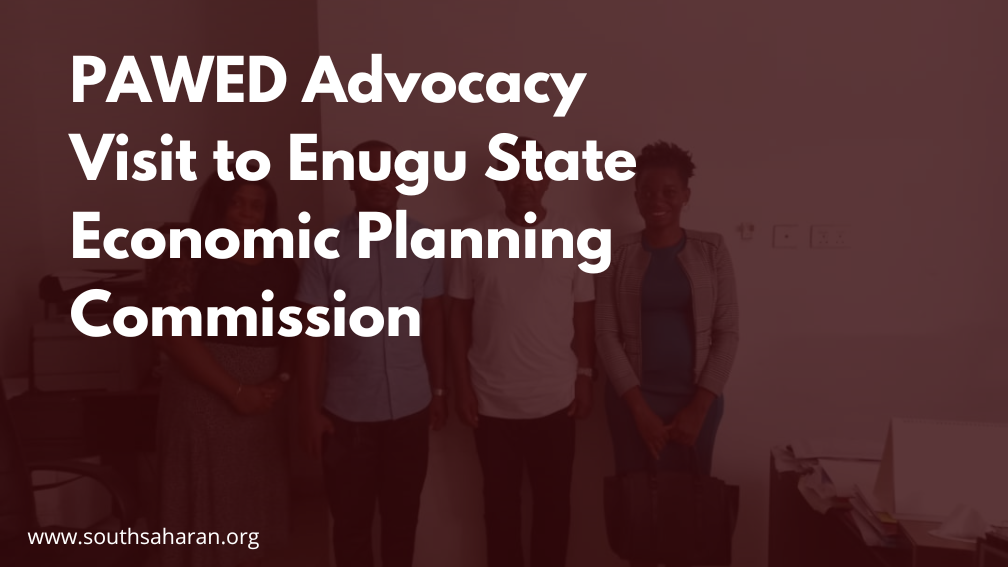
On Thursday, 9th June 2022, members of the PAWED coalition embarked on and advocacy visit to the Enugu State Economic Planning Commission.
Participating in the advocacy visit were:
Nkem Awachie (South Saharan)
Nebo Collins (New Century Initiative)
The participants were welcomed into the office of the Director and sat down to have a meeting with the following officials present:
Mr. Dan Onyishi (The Director)
Barr. Ifeoma Chukwurah (Legal Advisor)
The participants introduced themselves and the PAWED project. They explained that the advocacy visit came as a follow-up to the recently-concluded policy dialogue session on Women’s Economic Empowerment.
At the policy dialogue session, one major issue raised was the inadequate budgetary allocations for the implementation of policies and projects for women’s economic empowerment.
Hence, the participants recommended that the Economic Planning Commission:
Work to increase the budgetary allocation for the implementation of WEE projects and policies in Enugu State.
Ensure that WEE budget items are duly implemented, not rendered ineffective by bureaucratic bottlenecks.
Ensure transparency in the awarding of contracts and selection of beneficiaries for WEE projects and policies.
The Director commended the coalition members on their proactive pursuit of Economic Empowerment for women.
He pointed out that the government already has a number of economic schemes and programmes, of which many of the beneficiaries are women. He however, could not immediately provide links to these programs, which indicated a need for an easily accessible online database for government economic empowerment programs and opportunities.
He also mentioned that they had taken steps to facilitate poverty alleviation and socio-economic empowerment of citizens by producing a Social Protection Policy for Enugu State. The Policy represents Enugu State’s adoption and domestication of the National Social Protection Policy, putting in mind the indigenous culture and aspirations of the people. It encompasses measures that could be adopted to enhance the social well-being of the citizens of the State, as well as implementation framework and modalities for effective monitoring.
He however admitted that more could still be done, but that would be within the purview of other Ministries responsible for the direct implementation of economic programs and schemes.
He assured the participants that the Economic Planning Commission is open and proactive, and would be happy to support the push for Women’s Economic Empowerment in Enugu state.
Research shows a 6.3 percent unemployment gap between men and women in Nigeria. This highlights a rather obscure fact that is holding the nation back. Understanding the importance and necessity of women’s empowerment in this time and era, the Development Research and Project Center, (dRPC) in partnership with South Saharan Social Development Organization, (SSDO) is implementing the Partnership for the Advancement of Women’s Economic Development (PAWED) project.
The PAWED project was formed to strengthen the capacity of women’s economic collectives in Enugu state to conduct high-impact evidence-informed advocacy to improve the livelihood of economically active women and girls in the state.
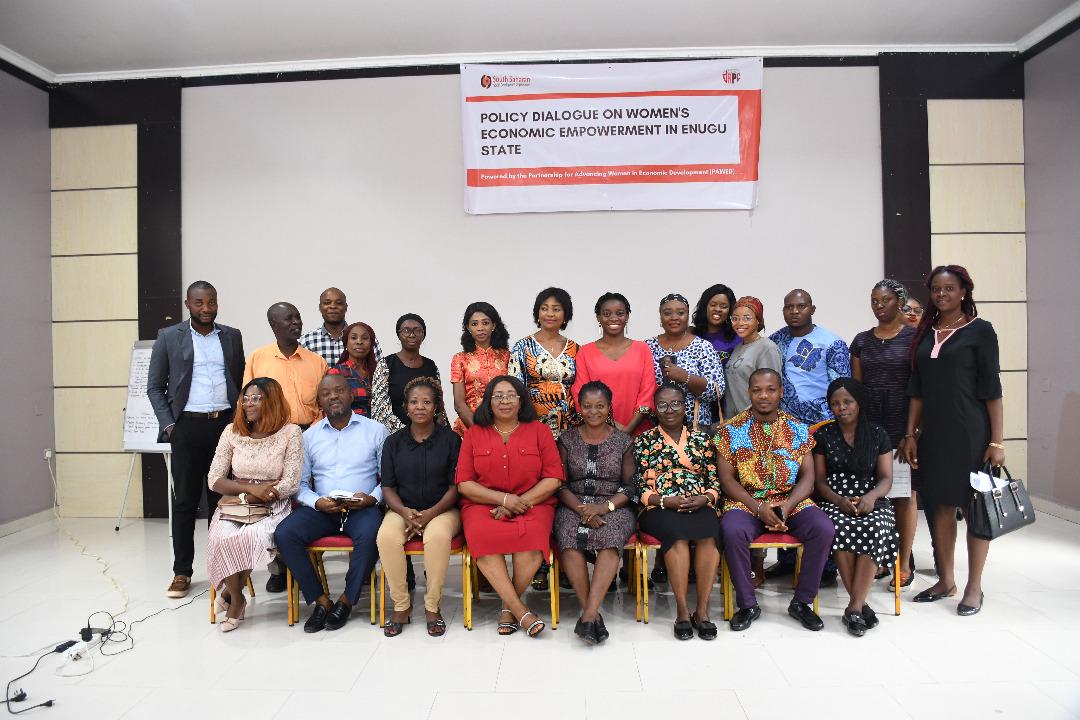
In April 2022, the PAWED project held a Policy Dialogue Session to provide a platform for synergy between stakeholders in Enugu State for effective advocacy for Women’s Economic Empowerment (WEE). The stakeholders included:
Women-led, women-focused Civil Society Organizations
Women’s Economic Empowerment Cooperatives
Representatives from relevant government ministries.
Academia – University of Nigeria (UNN) Gender and Development Centre.
Media representatives
Specifically, the policy dialogue session aimed to achieve the following:
Achieve a consensus on the most pressing WEE issues in the state
Identify key policy and regulatory frameworks that will facilitate and accelerate the delivery of WEE projects
Proffer solutions and recommendations for the furtherance of Women’s Economic Empowerment (WEE) in the state
Produce policy brief documents for succinct and effective advocacy
Come up with an effective advocacy strategy based on synergy amongst the different stakeholder groups.
The session started with an overview of the Comparative Analysis of the Subnational 2022 WEE Budgetary Allocation. After which they reached a consensus on pressing WEE issues in Enugu their specific causal factors. Some issues identified were:
Poor prioritization of WEE funding.
Lack of WEE project coordination.
Duplication of WEE budget lines.
Lack of availability of WEE projects.
Poor monitoring and evaluation culture.
Participants discussed and proposed several recommendations to tackle issues relating to women’s economic empowerment in Enugu State. Proposed solutions include:
Improving access to quality education for women.
Providing better healthcare and social protection.
Strengthen the digital skills of women to bridge the digital gender gap
Promoting policies that enhance human capital development.
Eliminating all forms of violence and discrimination against women.
Strengthening active policies to build a more inclusive labor market targeting gender wage gap, integration, and advancement of women of diverse backgrounds
Advancing multi-stakeholder partnership to update new initiatives for promoting women’s empowerment.
Finally, the participants also devised advocacy strategies to improve the WEE situation in the state, with the government representatives pledging to facilitate advocacy visits to the senior management teams of government agencies responsible for WEE.
WORKSHOP REPORT: PARTNERSHIP FOR ADVANCING WOMEN IN ECONOMIC DEVELOPMENT (PAWED)
BACKGROUND
Women in South Eastern Nigeria face many hurdles in their quest for economic empowerment. They contend with gender discriminatory cultural practices and social norms, unpaid domestic labor, and low access to capital. These and other constraints keep women poor and financially dependent on their male counterparts.
The development Research and Projects Centre (dRPC), has partnered with South Saharan Social Development Organization (SSDO), to form the Partnership for Advancing Women in Economic Development (PAWED). One of the first activities of the PAWED project was to form a coalition for Women Economic Empowerment, consisting of women-focused and women-led CSOs and WECS. This coalition was inaugurated in a 2-Day Advocacy Training and Inauguration of the Women’s Economic Empowerment (WEE) Coalition.
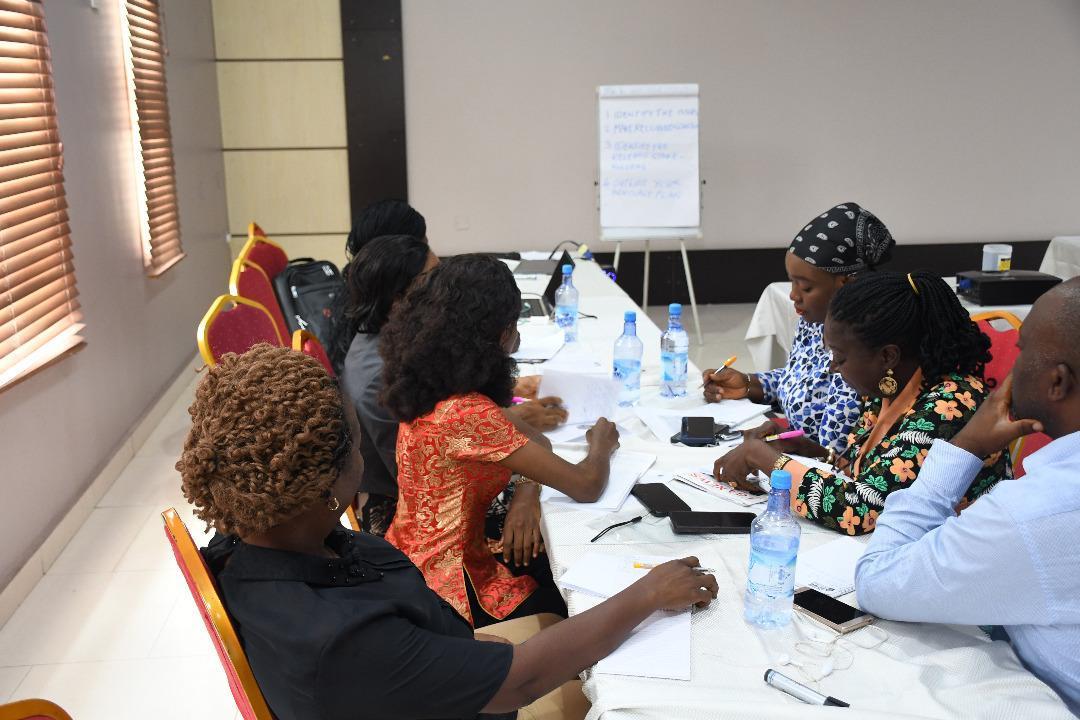
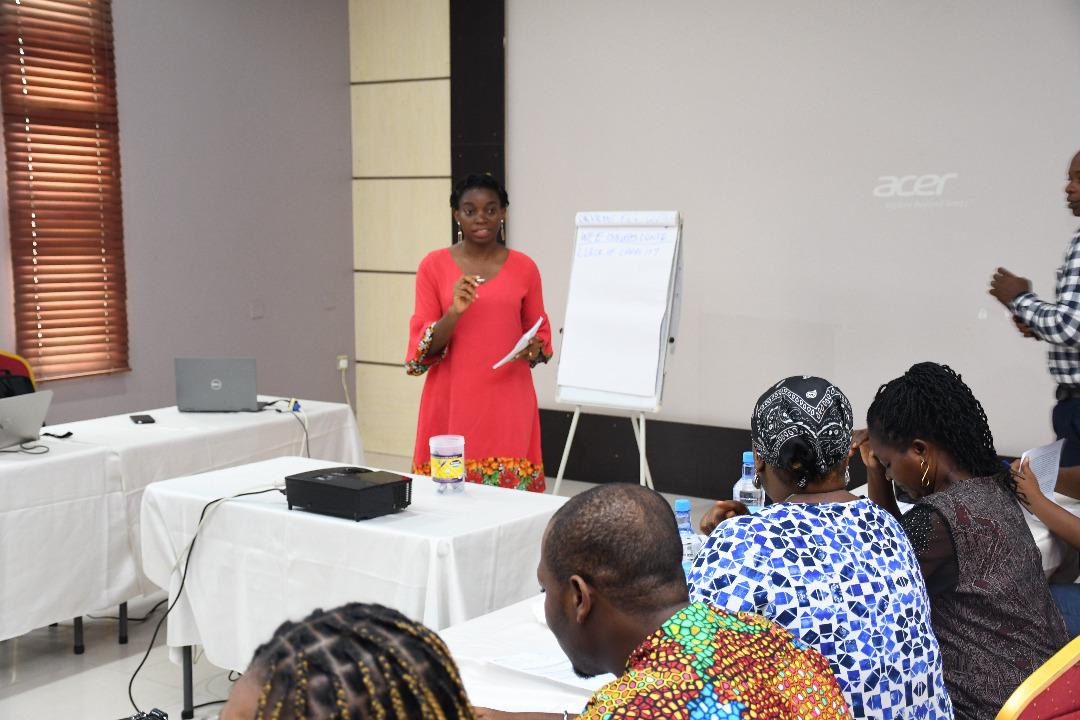
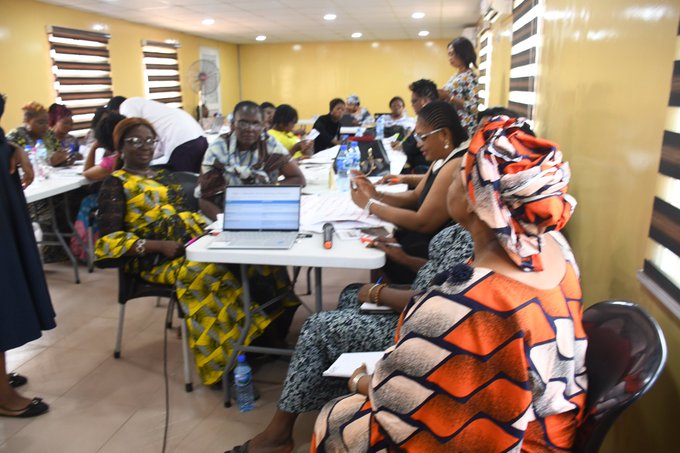
The workshop was held in Enugu, Nigeria from Friday 25th to Saturday 26th February 2022.
OBJECTIVES OF THE TRAINING
This event had the following objectives:
· To formally constitute the state WEE Coalition;
· To introduce the PAWED project’s objectives
· To build the capacity of coalition members on advocacy for Women’s Economic Empowerment
PARTICIPANTS’ PROFILE
The workshop participants included members of women-led Civil Organizations (CSOs), Women’s Economic Empowerment Cooperatives (WECs), and representatives from relevant government Ministries.
Participants cuts across duly-registered organizations and cooperatives who have successfully executed projects that are geared towards empowering women and engendering women’s development.
TRAINING METHODOLOGY
Learning was achieved through presentations by experts (the team of facilitators) as well as through group work.
WORKSHOP OVERVIEW
The workshop was opened at 10:30 a.m. with a welcome statement by the Executive Director of SSDO, Dr. Stanley Ilechukwu. He gave a brief overview of the vision and mission of SSDO and concise background of the PAWED project.
Dr. Stanley stated the need for social justice and women empowerment through a transformation of economic, social, and political structures at state and national levels. He acknowledged the resourcefulness of the facilitators and urged participants to utilize this opportunity and make the best out of the workshop. He finally wished all participants a good and successful training workshop.
Afterward Alaya Biliqis, the lead facilitator thanked the participants of the workshop for being in attendance and thereafter introduced herself and the team of facilitators. They are a team of four (the lead facilitator inclusive).
1. Alaya Biliqis
2. J. AGBA OGAR
3. Damilola Praise Rotimi
4. Lawal Moshood O. (Ph.D.)
DAY ONE
SESSION 1: Welcome and Introduction (by Alaya Biliqis)
The lead facilitator, Alaya Biliqis commenced the workshop with an ice breaker with the intent of encouraging familiarity with the facilitators and other participants. Participants were encouraged to network with each other and share their work area in women’s economic empowerment. The ground rules were also initiated by the participants.
SESSION 2: Introduction to Advocacy (by Damilola Praise Rotimi)
This session was geared towards defining Advocacy, discussing its basic elements/steps, and as well determining the differences between Advocacy and lobbying. It was established that there are different definitions of Advocacy but the facilitator went with the definition of Wikipedia and Alliance for Justice as seen below.
“Advocacy is an activity by an individual or group that aims to influence decisions within political, economic, and social institutions” – Wikipedia
And “Advocacy is defined as any action that speaks in favor of, recommends, argues for a cause, supports or defends, or pleads on behalf of others” – Alliance for Justice
Advocacy was seen as both a science and an art. Science: because it involves systematic planning, and each step requires distinct knowledge and skills. Art: because it involves articulating issues in ways that inspire people to action. It involves negotiating and consensus-building, incorporating creativity, style, and even humor.
Elements of Advocacy
Advocacy starts with a core group of people and organizations concerned with a particular issue who are willing to commit resources, including time and expertise to bring about change. Advocacy is a process but does not always take place in a defined or rigid step-by-step manner, the process to be followed varies depending on the Advocacy goal/objectives, the groups involved and the environment in which the Advocacy is taking place.
More so, the basic steps involved in Advocacy constitute the elements. In all situations, it is always advisable, to begin with, the goals and objectives, other steps to follow depend on the group and resources that exist, for example, if a group has considerable data and data expertise already they may decide to go ahead to develop a position paper, another group might decide to delay the development of a position paper until they have formed a strong coalition, depending on available resources (financial and human) some activities may take place simultaneously.
Advocacy and Lobbying
“Lobbying” is one of the tactics used in Advocacy, however, for this dRPC project, there is a special consideration. In some countries, charities and non – governmental organizations are prohibited from using government funds (including grants and revenues from contracts) to lobby. This dRPC Project falls into this category. To help the participants to further understand the issue the guidelines used by the United States, State of Oregon was helpful.
Lobbying
You are lobbying when you:
• Talk or write a legislator or his or her staff to influence legislative action. This includes:
o Testimony favoring or opposing a bill or budget
o Proposing amendments to a bill, including technical amendments
o A letter, memo, or email favoring or opposing a bill or budget
o Formal or casual conversations favoring or opposing a bill or budget
• Talk or write to a legislator or to his or her staff to promote goodwill toward an agency or program
• Talk or write to others with the intent to ask them to influence legislative action. This includes:
o Meeting where you ask people to support or oppose a bill
o Letters, memos, emails, or newsletters asking people to support or oppose
You are not lobbying when you:
• Talk to or write to a legislator or his or her staff merely to provide facts. (Facts may include fact estimates or expert opinion of facts). The facts may apply to any program, budget, bill or issue.
• Do work within your agency to do research, write or otherwise develop a bill or budget
• Research or write testimony supporting or opposing a bill
• Are waiting to present testimony or meet with legislators or staff
• Write or talk to anyone to solicit their input on an agency’s legislative proposals or bill
• Do support work for an agency’s lobbying activities, but do not communicate, yourself, with legislators and staff
SESSION 3: Defining advocacy goal and objectives (by J. Agba Ogar)
The focus of this session, participants will be able to determine and develop Advocacy goals and objectives. Participants were also trained to explain specific elements of the Advocacy objective.
Goal and objectives both describe what a person wants to achieve; a goal is a broad statement of purpose we use to chart our course and objectives are specific statements of how the goal will be achieved.
An advocacy goal is a long-term general aim to solve an outstanding issue, for example, to increase male involvement in order to improve the reproductive health of Samoan families. For each goal, several objectives need to be defined. “An advocacy objective focuses on a specific action that an institution can take. This action is a specific measurable step towards the goal.
To define your advocacy objectives, ask the following questions:
• WHAT do we want to change?
• WHO can make the change?
• BY HOW MUCH?
• BY WHEN?
SESSION 4: Issues/Barriers and Threats Facing WEE In Nigeria (by Lawal Moshood O., Ph.D.)
This session had the aim of helping participants to know how to define Women Economic Empowerment (WEE), identify and frame Key Advocacy issues affecting WEE in Nigeria, discuss key issues affecting WEE in Nigeria and also explain the differences between threats and barriers experienced by women in business and their impact.
Women empowerment is defined as the process in which women elaborate and recreates what it is that they can be, do, and accomplish in a circumstance that they previously were denied. Alternatively, it is the process for women to redefine gender roles that allows them to acquire the ability to choose between known alternatives that have otherwise been restricted from such ability Women’s empowerment is seen as involving the transformation of economic, social, psychological, political, and legal circumstances of women.
Key Issues Affecting WEE in Nigeria?
Gender Equity (GE) is a Second-tier Federal Government of Nigeria (GoN) Priority.
GON stakeholders agree to GE/WEE in principle – and in public. Yet, these concepts are rarely reflected as priority objectives in key GON programs and policies some laws deny women equal opportunities with men such as land ownership and opportunities to invest freely. These laws function as a handicap to women’s economic capabilities and perpetuate a culture of dependence. There is still a wide gap between men’s and women’s representation in political leadership. Despite the affirmative action of 30% for women in all political structures at the 1995 international women conference, reviews have shown that Nigeria has not reached that level.
Limited Funding
A lack of GE policy prioritization and Nigeria’s tightening fiscal space has led to reduced budgetary prioritization of GE and relatively meager funds for WEE-focused programming. An analysis of the federal budgets since 2017 has shown that women in agribusiness receive the lowest funding annually. In the budget (2017-2021), the government allocated N416 million to women in agribusiness. Women in agriculture are believed to be the major food producers in the sector.
Weak, Ad hoc, Merged Programmes
Weak, ad hoc, merged programs GE/WEE programs are generally ad hoc, separate from broader policy priorities, and often merged with efforts to support other vulnerable groups like youth, children, and the disabled. The Federal Government is spending N5.6 billion on women empowerment and the fight against Gender-Based-Violence (GBV) this year (2021). While this is welcoming, there is no good provision for accountability in terms of measuring the proportion of each program.
Welfare as Empowerment
WEE is conflated with social welfare. Transfers-based models dominate and are often deployed as political tools. As a result, the Government of Nigeria’s GE interventions rarely lead to systemic change.
Technical Capacity Bottlenecks
High-potential programs – including Nigeria for Women Project – have suffered from weak implementation capacity, especially at the state level.
Poor Database
For WEE projects and initiatives around the country, there has been a poor data management system to help track the progress and true status of the work done in various states of the country. This also contributes to the challenges faced in the sustainability of the several WEE initiatives.
Pet Projects
It has been established how each of the first ladies at one point or the other tried to empower women and each of their efforts was halted mostly due to a change in government. Hence why most of the First lady projects or programs do not exceed their tenure once they are out of office because every first lady wants to own her own legacy and as such create gaps in the development or impacts already made by a predecessor. There is therefore a need to advocate for programs to be more people-oriented to ensure continuity and sustainability even after a change in any government.
Nigeria’s Patriarchal Societal and Government Structures and Norms Reinforce Gender Inequality
It is hard – and even politically costly in some cases – for GE/WEE to emerge as policy priorities). Political advisors are less likely to support female candidates making it difficult for them to make headway in the political space. Male domination in politics and decision making over the years have made it difficult for women to hold political office
At the end of this session, participants were grouped into four (4) to do advocacy on women marginalization (economic, social, political, etc.) and develop a goal and objective(s), guided by a template shared earlier.
SESSION 5: Coalition Building (by Alaya Biliqis)
This session had the purpose of training participants to discuss coalition building and explain the benefits of coalition building. It also aims at explaining the challenges of coalition building to the participants. The participants were trained on the key steps in coalition building and how to incorporate influencers into Advocacy coalitions.
DAY TWO
SESSION 6: Identifying/mapping your advocacy audiences (by Damilola Praise Rotimi)
The participants were trained in this session on how to define their Advocacy Audiences and most importantly, determine different Advocacy Audiences, map different Advocacy Audiences and as well define political gatekeepers and Advocacy champions.
SESSION 7: Advocacy Research – Data Collection, Information and Testimonies (by J. Agba Ogar)
The focus of this session was to train the participants on the importance of research to the success of Advocacy. They were also trained to differentiate between different Advocacy Research Methods.
SESSION 8: Preparing Your Position Paper and Fact Sheets (by Lawal Moshood O., Ph.D.)
Participants were trained in this session on the content of an Advocacy position paper and on how to draft fact sheets.
SESSION 9: Handling Objections – from your opponents (by J. Agba Ogar)
The key objective of this session was to train the participants on how to recognize objections to their Advocacy message and as well determine ways to handle objections from their opponents.
SESSION 10: Improving Your Advocacy Skills (by Damilola Praise Rotimi)
The participants in this session were trained to identify key skills required for successful Advocacy and also on how to deploy these skills necessary for Advocacy success.
SESSION 11: Message Development and Delivery
The goal of this session was to train participants on how to write up effective Advocacy messages, be conversant with the characteristics of effective Advocacy messages and so develop an effective Advocacy message. They were also trained to develop the One Minute message.
SESSION 12: Innovative and Culturally Responsive Approaches and Messaging to Conduct Advocacy in Nigeria
Participants were given a proper understanding on innovative and culturally responsive approaches to Advocacy in Nigeria and at the end trained to deploy those innovative approaches for effective Advocacy.
SESSION 13: Action Planning
Participants were trained to write up an Action Plan for Advocacy Initiative and Coalition • they were also taught the key elements of an Action Plan.
SESSION 14: Monitoring and Evaluation
In this session, participants were trained to identify key factors to take into consideration for Advocacy monitoring and evaluation. The remaining period in this session was spent on training participants on Advocacy monitoring and evaluation. One of the examples used was the budget tracking process.