

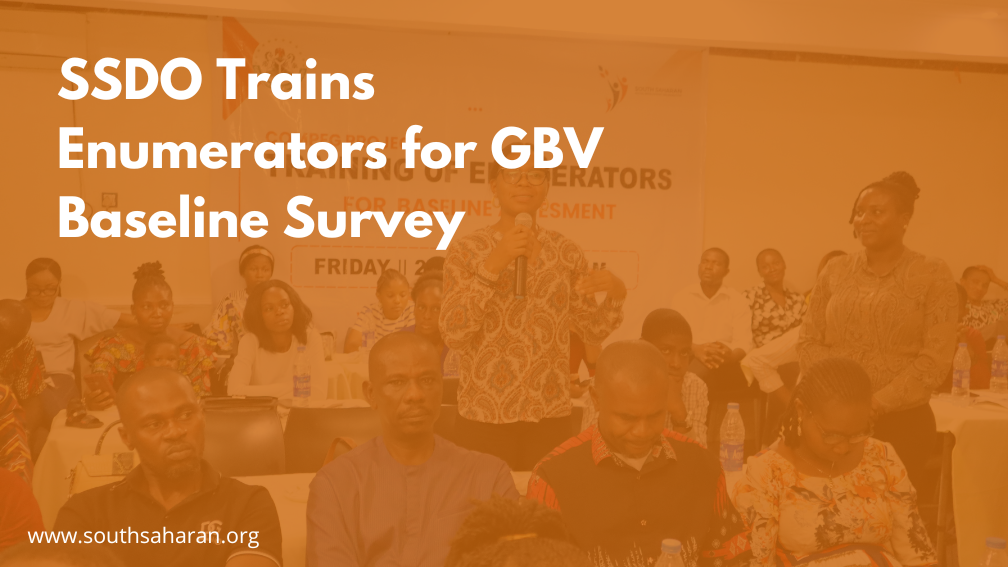
In a significant stride towards addressing gender-based violence (GBV) in Enugu State, the South Saharan Social Development Organization (SSDO), in collaboration with the Ford Foundation, recently concluded a comprehensive training session for enumerators. This training is part of the Community Partnership for the Elimination of Gender-Based Violence (ComPEG) project, aimed at eliminating harmful practices and norms that perpetuate GBV in rural communities through data-driven, community-based interventions.

The training, which took place on the 27th of September 2024 at the Bridge Waters Railway in Enugu, brought together enumerators, supervisors, and key stakeholders from across the state to prepare for the upcoming baseline survey. The survey will be conducted across all 17 Local Government Areas (LGAs) of Enugu State, providing essential data that will help shape targeted interventions to reduce the prevalence of GBV and other pressing social issues.

Why the Training Matters
Gender-based violence remains a critical public health issue, with long-lasting impacts on individuals, families, and communities. The ComPEG project seeks to address these issues by engaging local institutions, including traditional leaders, government representatives, and community members, in driving accountability and reform. A crucial aspect of this effort is the collection of accurate, community-specific data to guide and inform future interventions.

The training of enumerators is an essential step in this process, equipping participants with the knowledge and skills necessary to conduct the baseline survey efficiently and ethically. The training agenda covered a range of critical topics, including:
– An overview of GBV and its incidence in Enugu State.
– Ethical considerations in data collection and household mapping.
– Introduction to the mWater tool for data collection and analysis.
– Survey methodologies related to GBV, child labor, antimicrobial resistance, toilet financing, and poverty indicators.
– Role-playing exercises to ensure preparedness in real-world field situations.

By the end of the training, the enumerators were fully prepared to conduct the survey, ensuring that all data collected will be accurate, comprehensive, and aligned with the project’s objectives.
Collaboration for Lasting Impact
The SSDO team, led by Gender and Protection Officer, Blessing Uchendu, worked alongside representatives from the Ministry of Children, Gender Affairs, and Social Development (MCGASD) to ensure that all enumerators were equipped not only with technical skills but also with a deep understanding of the sensitive nature of the data they will be collecting. During the session, Cheta Okonkwo Eze from MCGASD provided critical insights into the state’s GBV and child labor landscape, further emphasizing the importance of ethical data collection practices.

Additionally, participants were introduced to the use of mWater, a digital tool that will be utilized for data collection, making the process more efficient and secure. The data gathered will form the foundation for future interventions, allowing SSDO and its partners to focus resources where they are most needed.
Looking Ahead
Following the training, enumerators will be deployed across the 17 LGAs to conduct the baseline survey over a six-day period. The data collected will provide valuable insights into the prevalence, patterns, and drivers of GBV in Enugu State, as well as other intersecting issues such as child labor and antimicrobial resistance.

This survey represents the first step in a broader effort to create safer, more equitable communities in Enugu State. By identifying high-risk areas and establishing a baseline for future interventions, the SSDO aims to drive real, measurable change in the fight against GBV.
Our Commitment
At SSDO, we are committed to reducing GBV and promoting gender equality through innovative, data-driven approaches. The ComPEG project is a testament to this commitment, and we are grateful for the support of our partners, including the Ford Foundation, for making this critical work possible.
As the baseline survey gets underway, we look forward to sharing updates on our progress and the impact of our work. Together, we can create a future where everyone is safe from gender-based violence.
Stay Connected!
For updates on the ComPEG project and other initiatives, follow us on our social media platforms: