SSDO

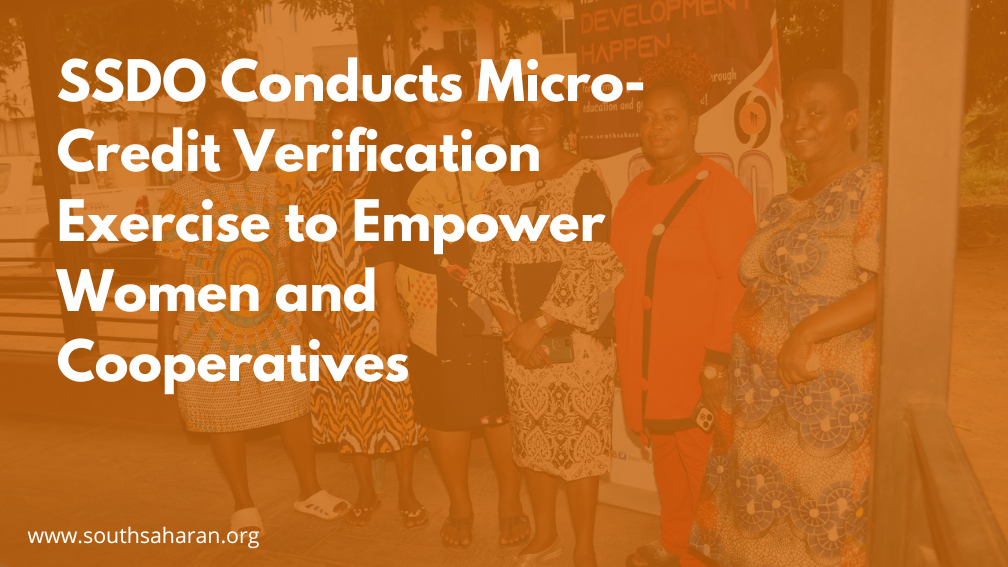
SSDO Conducts Micro-Credit Verification Exercise to Empower Women and Cooperatives

In many communities, women remain financially dependent on their spouses, often limiting their autonomy and ability to escape situations like gender-based violence. This dependence, compounded by poverty, leaves them vulnerable and trapped in cycles of inequality. At South Saharan Social Development Organization (SSDO), we believe that empowering women economically is a powerful way to break these chains, fostering independence, confidence, and long-term sustainability.

One of the initiatives SSDO employs to achieve this is the Jacob’s Well Micro-Credit Scheme. This program provides low-interest loans to women in cooperatives, enabling them to start or expand their businesses. By leveraging social trust within these cooperatives, women can access financial support without the burden of collateral, making it accessible to those who need it most.

The Role of Business Verification 

A key component of ensuring the success and integrity of this program is the verification and evaluation exercise. Before loans are approved, SSDO’s micro-credit officers conduct a thorough verification process, visiting applicants’ businesses to assess their structure, credibility, and potential for growth. This step is essential in determining eligibility for a loan and deciding how much each applicant should receive.

In August and September 2024, SSDO’s Micro Credit Officer, Stella Ani, embarked on a verification exercise, visiting 71 business locations across communities in Enugu State. This process allowed SSDO to better understand the applicants’ businesses, verify their legitimacy, and assess the progress of previous loan recipients.

Building Trust Through Transparency

The verification exercise is more than just an administrative procedure—it builds trust between SSDO and the women who rely on these loans to secure their futures. By taking the time to visit each business, our team can ensure that the loans are being used effectively, promoting accountability and encouraging responsible borrowing. It also helps SSDO gain insights into the challenges these women face in running their businesses, informing future improvements to the micro-credit scheme.

Fostering Women’s Financial Independence

At its core, Jacob’s Well is about more than just providing financial assistance; it’s about fostering independence. By supporting women-owned businesses, SSDO is helping women take control of their financial future, reducing dependency on spouses or other family members, and allowing them to achieve self-sufficiency. For many of these women, a successful business means not only supporting their families but also being able to reinvest in their communities, contributing to the broader goal of poverty alleviation.

Going Forward 

SSDO’s commitment to empowering women through initiatives like Jacob’s Well is stronger than ever. We will continue to provide resources and support for women to succeed in business, ultimately transforming their lives and communities. The recent verification exercise serves as a reminder of the tangible impact of micro-credit programs in helping women build sustainable livelihoods. 

As SSDO moves forward, we remain dedicated to providing innovative and inclusive solutions that address the unique challenges women face, particularly in economically disadvantaged communities. Through financial empowerment, we can help women break the cycle of poverty and dependency, unlocking their full potential to lead, grow, and thrive.

EMPOWERING WOMEN THROUGH ADVOCACY AND CAPACITY BUILDING: SUCCESS STORIES FROM IBUTE-NZE, AWHA-NDIAGU, AND AFFA-AMOFIA

After the successful establishment of the VSLA groups in Ibute-Nze and Awha-Ndiagu community, the Sister Guardian Initiative project team conducted a monitoring visit to the communitiesThis provided a valuable opportunity to mentor the newly established group and assist in the drafting of their constitution. 

Beyond the VSLA monitoring, the team monitored the initiative’s progress, build the capacity of the Sister Guardians, and conduct a need assessment evaluation to strengthen the initiative in the target communities.

During the visit to Ibute-Nze, it was discovered that the women had challenges with harvesting their farm produce as they were constantly being harassed by community nuisances. The Gender Program Lead sensitized them on how to conduct advocacy to community leaders and decision-makers. This was done and has helped to curb the harassment. 

In Awha-Ndiagu, the women were supported to champion an advocacy effort for the rehabilitation of the community health center and school hall of Community Secondary School Awha-Ndiagu. Because of the state of the school hall, the final year students couldn’t write their WAEC examinations in the school. The endeavor led to the successful renovation of the school. After the renovation, the students were able to take the NECO examination in the school. 

“Through the support and guidance of the Sister Guardian Initiative, we have not only learned how to advocate for our rights but have also seen tangible evidence in our community that advocacy works.” a member of the Sister Guardian from Awha-Ndiagu shared

In Affa-Amofia community, the team used role play to teach the women how to advocate effectively and the right target group to engage to see results.

A Mother’s Resilience: Juliet’s Journey to Reunite with Her Children

Gender-based violence (GBV) remains a pervasive issue in Nigeria, affecting countless women and girls across the country. Despite ongoing efforts to combat this scourge, many continue to suffer in silence, enduring physical, emotional, and psychological abuse. The effects of GBV on victims are profound, often leading to long-term trauma, health complications, and a pervasive sense of fear and helplessness. In addition to the immediate harm inflicted, victims frequently face societal stigmatization, further isolating them and complicating their paths to recovery and justice.

In the face of such adversity, the story of Juliet Ngene stands out as a poignant example of resilience and the transformative power of dedicated support systems. Juliet, a mother of five, endured relentless abuse and unfounded accusations from her husband. Her journey, marked by separation from her children and prolonged suffering, highlights the critical role that organizations like the South Saharan Social Development Organization (SSDO) and the National Agency for the Prohibition of Trafficking in Persons (NAPTIP) play in supporting victims of GBV. 

Through their efforts, Juliet was ultimately reunited with her children, showcasing a powerful narrative of hope and recovery amidst the pervasive issue of gender-based violence in Nigeria.

Juliet Ngene is a devoted mother of five and is a tailor. Her husband who is supposed to be the family’s breadwinner is a bricklayer, whose job is seasonal. To make ends meet and support her family, she travels to Onitsha to buy materials which she resells in Enugu. From her proceeds, she caters to feeding and also pays the house rent. Sometimes, she also loans her husband money to help him sort out other bills. 

Things took a harrowing turn when Juliet’s husband’s attitude changed towards her. He became abusive and leveled unfounded accusations against her. 

Due to the nature of her job, she had to make several trips to purchase materials. And as a result on some occasions won’t be able to make it back home. On those occasions, she’d stay with her sister in Onitsha.

“He kept accusing me of sleeping with other people. And he knows I have to make those trips to support the family. I will explain myself to him and that in itself will be a precursor for slaps and heavy beatings,” 

“I have told him that anytime I can’t make it home I’d stay at my sister’s, then come to Enugu the next day. That didn’t seem to help. If I come home late due to the distance, he would insult me that I have gone out with my lovers. I couldn’t do anything right in his eyes,” 

 “No matter what I said, he never believed me. Going home after work became a nightmare,” she shared. His accusations were a pretext for driving Juliet out of their home in Enugu.

The husband reported the case to the kinsmen who summoned the wife and her sister to the meeting. She gave her side of the story which the elders fact-checked with the sister. Despite her honest explanations and the corroboration from her sister, who confirmed she stayed with her during late returns from business trips, her husband remained unyielding. 

Desperate to sever ties, Juliet’s husband took drastic measures. He seized control of the properties, most of which Juliet had purchased, and took their children away. He dispersed the children among his relatives, sending three to Abuja and the two girls, Blessing, 16, and Divine, 11, to his sister in Ngwo, Enugu. For months, Juliet was cut off from her children, unable to contact them or ensure their well-being.

Lost and confused, she decided to visit her husband’s village to complain about his actions. And to also make inquiries and find out where are kids are But this yielded no results.  

Determined to reunite with her children, Juliet traveled to Ngwo upon learning that two of her children were there. What she found was heartbreaking: her daughters were malnourished and poorly cared for. When she attempted to take them with her, her husband threatened her, stating, “If I ever see you close to this place, I will deal with you.”

To worsen matters, she realized that her husband’s sister who had custody of the girls sent one to go and live with someone else in Anambra. SSDO’s Gender Officer discovered this while interviewing the older girl Blessing, “I would have run away from my aunt’s house, but I couldn’t because I didn’t know where my sister was taken to. I was scared and worried for her.” 

Despite the threats, Juliet persisted. Her search for assistance led her to SSDO. The Gender Protection Lead at SSDO connected her with NAPTIP, and together they began the arduous process of reuniting Juliet with her children. By May 23, their relentless efforts bore fruit, and custody of her children was restored to Juliet. 

Juliet’s prolonged struggle was exacerbated by her health issues, which left her bedridden and unable to search for her children sooner. “I was very ill and couldn’t move for days. It was only after my recovery that I could start looking for my children,” she explained.

After two grueling years of separation, malnourishment, and emotional pain, Juliet was finally reunited with her daughters, thanks to the unwavering support of SSDO and NAPTIP. Overwhelmed with gratitude, Juliet expressed, “I cannot appreciate SSDO enough for their efforts. Only God can repay you back. I am very happy and grateful.”

Juliet Ngene’s story underscores the critical role of organizations like SSDO in combating gender-based violence and advocating for the rights and well-being of vulnerable individuals. Her journey from despair to reunion is a powerful reminder of the resilience of the human spirit and the profound impact of compassion and advocacy in transforming lives. 

SSDO ESTABLISHES VSLA IN IBUTE-NZE COMMUNITY

We understand that poverty lies at the heart of unreported cases of Gender-based violence (GBV). Most women are often afraid they will lose their economic support if they report. Women have a huge role to play in nation-building. Gender inequality, unpaid care, and a largely unskilled women’s group are some issues to name a few that hold them back.

Women’s empowerment is one of the practical solutions to reducing the cases of violence against women. Understanding this, South Saharan Social Development Organization, through its Sister Guardian Initiative is empowering women in Ibute-Nze community by establishing a Village Savings and Loans Association. 

VSLA is a self-select savings group that uses members savings to lend to each other so they can grow their businesses. VSLAs offer a community-based financial platform that empowers women to invest in sustainable businesses. Through these community-driven financial solutions, women can secure the necessary funds to grow their enterprise. 

The VSLA in Ibute-Nze has been successfully set up and women trained in financial literacy and entrepreneurship. The group has selected its executives and is fully operational. The group will be monitored to proffer technical assistance and guarantee the sustainability and effectiveness of the VSLA operations.

SSDO ESTABLISHES VSLA IN AWHA-NDI AGU COMMUNITY

We understand that poverty lies at the heart of unreported cases of Gender-based violence (GBV). Most women are often afraid they will lose their economic support if they report. Women have a huge role to play in nation-building. Gender inequality, unpaid care, and a largely unskilled women’s group are some issues to name a few that hold them back.

Women’s empowerment is one of the practical solutions to reducing the cases of violence against women. Understanding this, South Saharan Social Development Organization, through its Sister Guardian Initiative is empowering women in Awha-Ndi Agu community by establishing a Village Savings and Loans Association. 

VSLA is a self-select savings group that uses members savings to lend to each other so they can grow their businesses. VSLAs offer a community-based financial platform that empowers women to invest in sustainable businesses. Through these community-driven financial solutions, women can secure the necessary funds to grow their enterprise. 

The VSLA in Awha-Ndi Agu has been successfully set up and women trained in financial literacy and entrepreneurship. The group has selected its executives and is fully operational. The group will be monitored to proffer technical assistance and guarantee the sustainability and effectiveness of the VSLA operations.